Agentic Commerce Reality Check(mate)
My Rebuttal to the Rebuttal to my Rebuttal

Is a rebuttal even needed to an article where Kiri Masters acknowledges I’m right no fewer than three times?

I’m not sure, but here we go anyway…
To catch everyone up to the origins of this debate: My first article on this topic—“Agentic Commerce is a Collective Hallucination”—was not exactly well-received by the pro-agentic crowd. In my follow-up, “Agentic Commerce Reality Check,” I describe the origins of collective hallucinations, citing the most famous example from history, the Salem Witch Trials. This phenomenon tends to occur within communities under duress, high suggestibility, and social contagion.
And we all know how that collective hallucination ended for the Salem witches.
I’m not surprised by the tech industry’s religious embrace of agentic commerce. Because they love a good collective hallucination, don’t they?
I mean, isn’t that what Burning Man is after all?

At this annual pilgrimage to the Nevada desert, a makeshift deity—a massive, 40-foot structure of a robot-like being—is the nexus for this collective hallucination. One where tech billionaires who fly in on private jets, stay in luxury tents, and hire private chefs somehow convince themselves they embody the festival’s anti-consumption ethos.
It turns out that when you peer closely at the Burning Man structure—once a vibrant symbol of creativity and community—it’s actually hollow. It’s just a large straw man.
But I digress… what was I talking about again?
Oh yeah, Kiri’s rebuttal to my “Agentic Commerce Reality Check” article.
I take on each of her arguments below.
The Category Error: Retail media doesn’t make money from transactions.
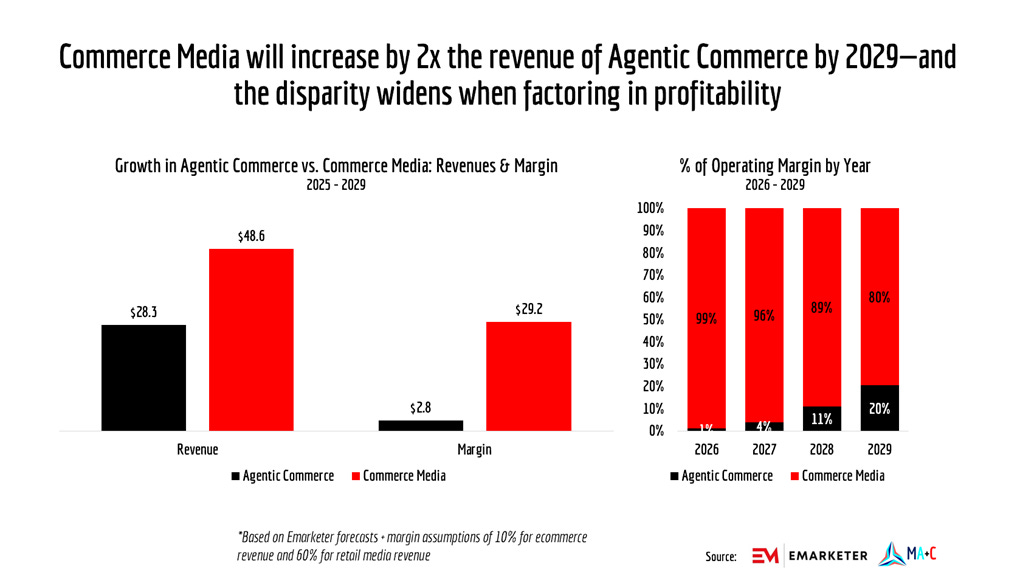
Kiri begins by taking on my analysis showing that retail media represents a ~2x bigger revenue opportunity and 10x bigger margin opportunity for retailers than agentic commerce over the next 4 years.
She writes:
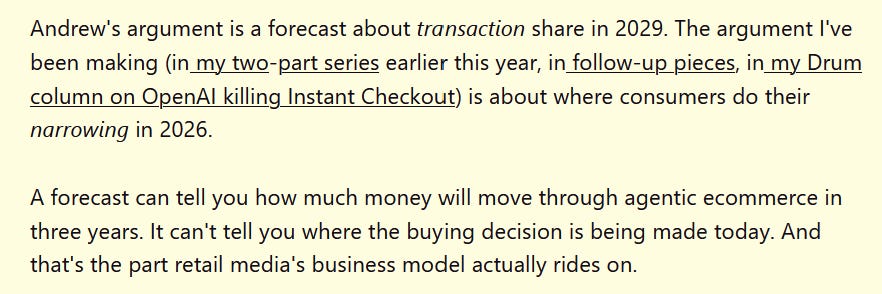
Kiri’s assessment tells only half the story. (Straw Man #1) The analysis she alludes to—which you can see for yourself below—addresses both the future of agentic transactions and the prospects for commerce media advertising through 2029. The revenue implications are important, but the margin disparity is the real story. It’s all about operating profit at the end of the day.
Kiri further argues that:

It’s true that retail media makes money from impressions, but transactions also drive ad monetization. Ad prices are a function of product demand, and if LLMs bring in more qualified shoppers with higher conversion rates, each individual ad impression becomes more valuable, offsetting the impact of a decline in impression volume.
She continues:
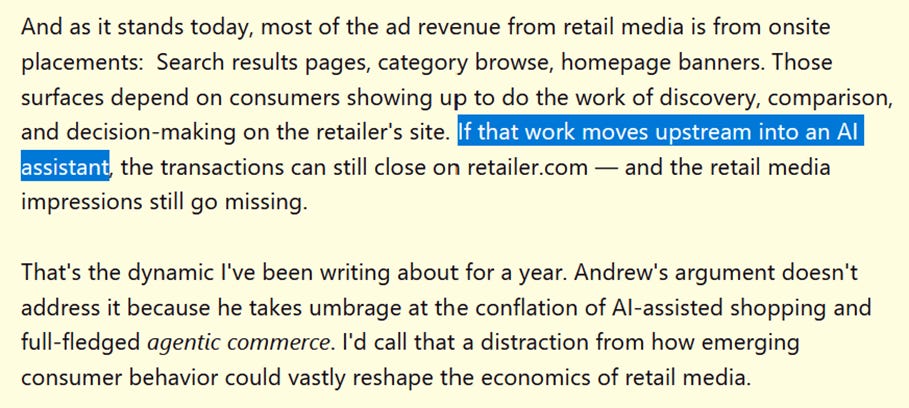
“If” is doing a lot of the heavy lifting in the highlighted portion. The “agentic commerce is an existential risk to RMNs” argument hinges on that “if” being true. Except that it’s really conjecture at this point, and current data reveal the opposite to be true (more on that below).
During my debate vs. Kiri at the Digital Shelf Summit in Atlanta—and on multiple stages before that event including ShopTalk—I discussed the analysis below. Within the top dozen retailers, there is a positive correlation between Gen AI referral percentage and Y/Y traffic growth.
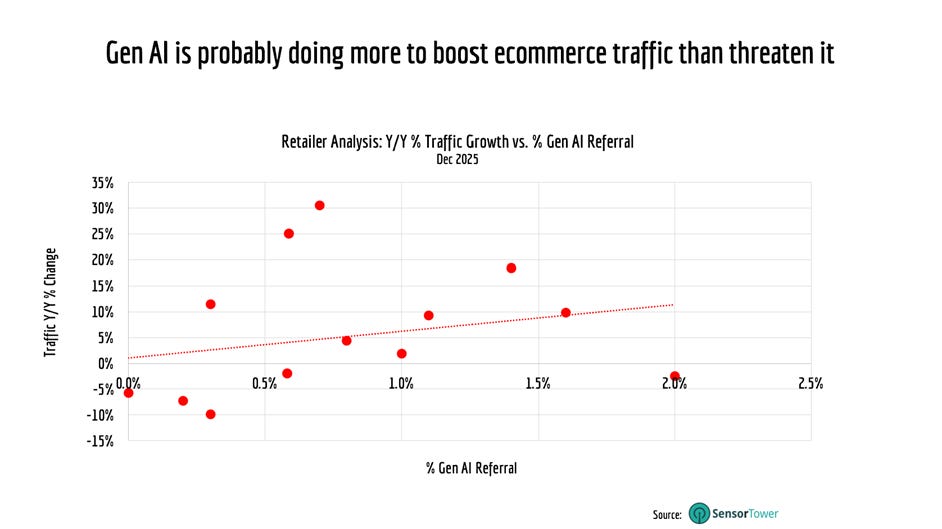
If on-site traffic were truly moving upstream into LLMs, wouldn’t you expect a negative correlation? Presumably, the greater a site’s dependence on Gen AI referral, the more pre-purchase activity would be pulled away from the site.
Instead, ecommerce traffic continues to grow. As do retail media ad revenues—as Amazon, Walmart, Target, and others can attest.
So, retailers and retail media are doing just fine. Meanwhile, ChatGPT may be the one facing trouble. Not only do Americans absolutely hate AI, ChatGPT’s early exponential growth has come to a complete standstill since last summer.
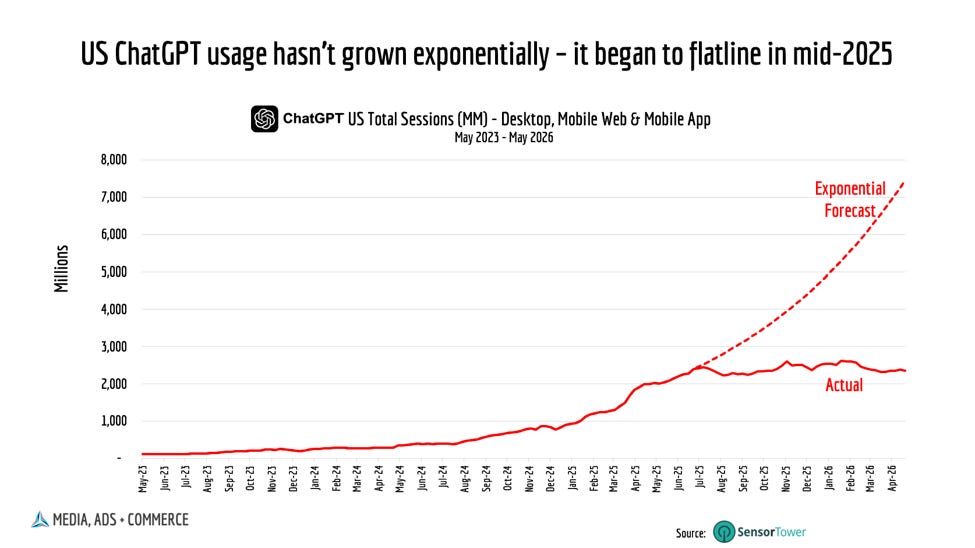
If agentic commerce has caused no discernible disruption, and the consumer AI trend is already running out of juice, what is the urgency for retailers to confront it as an existential crisis?
The New, Direct-to-PDP Shopping Journey: Shoppers will skip over where most retail media happens
Per Kiri’s argument above, AI-referred traffic to product detail pages (PDPs) constitutes the real threat to retail media since shoppers will skip the searching and browsing they’ve typically done on-site. She cites the high percentage of LLM-referred traffic that goes directly to PDPs from a Criteo study.
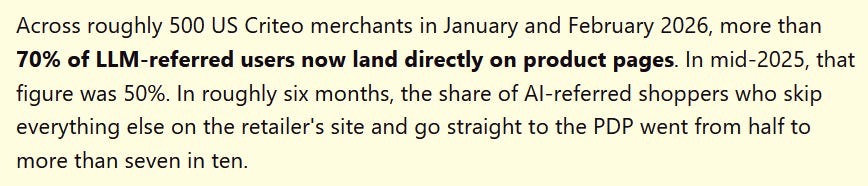
In order for this argument to carry water, two things must be true:
1. This percentage must materially outpace existing Google-referred traffic to PDPs. Google already refers product searches to PDPs, so for the LLM-referred user stat to represent a threat it must be notably different than existing search referral. One survey of ecommerce SMBs indicated that 41-60% was the most common response for percentage of inbound traffic going to PDPs. At minimum, a large percentage of traffic is already going to PDPs. And for large retailers (the ones with RMNs) with more advanced SEM and SEO strategies, that number is likely higher.
2. LLM-referred traffic can’t create incremental shopping and browsing activity to offset cannibalization. On this point, Kiri provides the counterargument herself when she cites Adobe data indicating that AI-referred visitors to ecommerce sites spend more time, view more pages, and convert better.
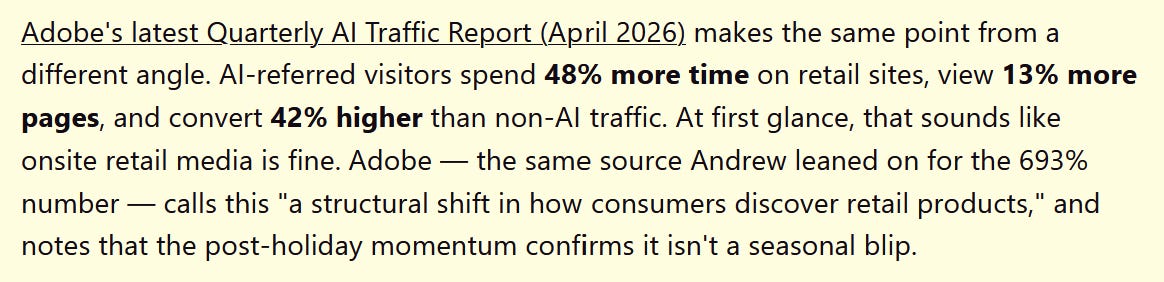
She continues…
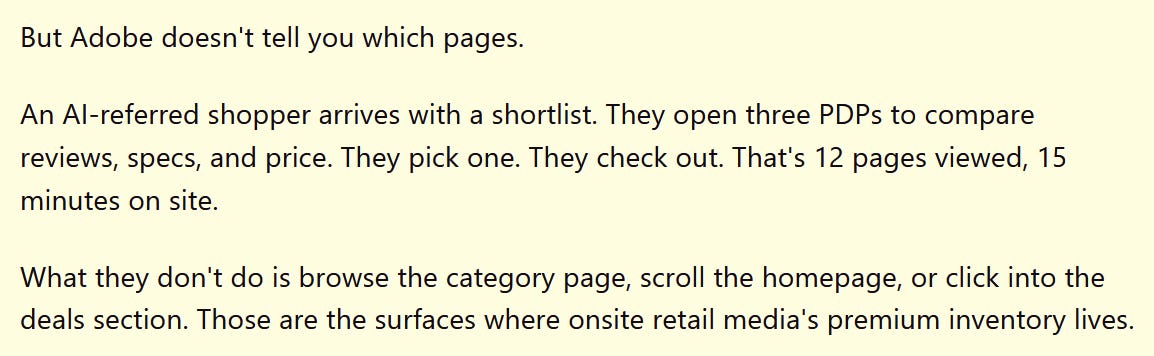
There are a lot of assumptions in these paragraphs, all of which are purely hypothetical at this point.
If we’re saying that AI-referred shoppers generate page views comparing SKUs at the bottom of the funnel, why is this experience any different than a shopper who arrives at the bottom of the funnel through a more traditional path to purchase? And since the traditional shoppers traffic the homepage, category page, and deals pages where these hypothetical AI-referred shoppers do not, wouldn’t the higher page view totals from AI-referred shoppers imply they are viewing way more pages at the end of the journey? And if that’s true, doesn’t it imply they have less certainty about their choices at the end of the shopper journey? But LLM-referred shoppers are supposed to come into the site more qualified than your average online shopper.
Recent data from Sensor Tower sheds some light on the reality of how AI-assisted shoppers behave. An analysis of Amazon Rufus (ahem, Alexa) sessions shows that conversion rates increase with the number of Rufus queries conducted in a session. While the baseline conversion for an Amazon session is 21%, sessions with 1-3 Rufus queries convert at 35%, 4-10 queries convert at 47%, and 11+ queries convert at 58%.
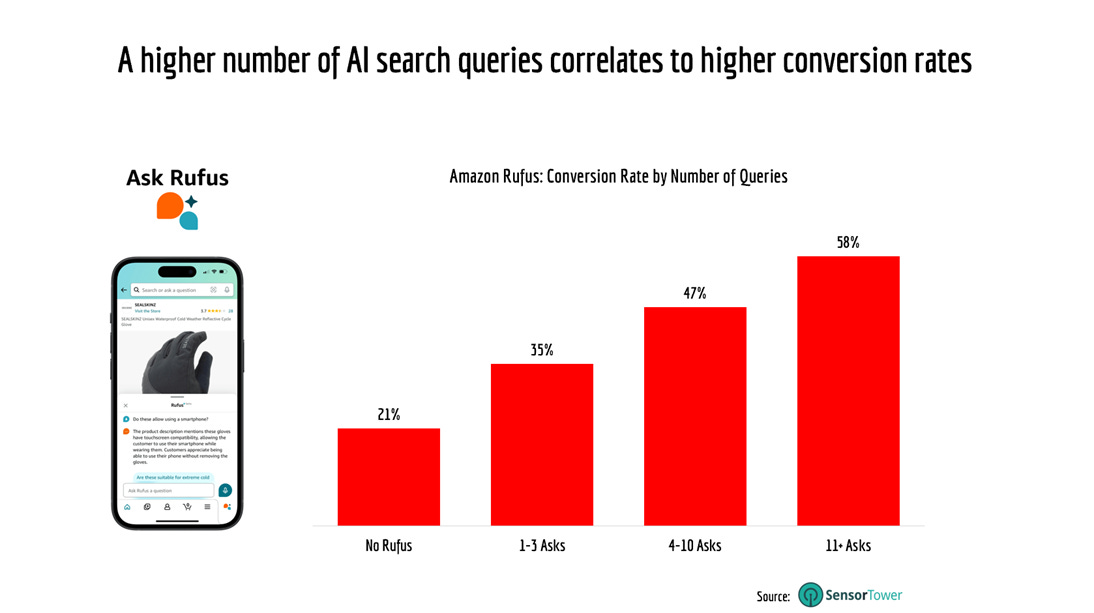
If the premise were true that agentic/AI-assisted shopping will reduce monetizable traffic, then why do multiple data points converge around the opposite being true?
Maybe shopping is less about efficiency and more about the process of building conviction in one’s purchase.
“But Upstream Influence Isn’t New”: Wrong, this time is different
In this section, Kiri takes on my counterargument that ecommerce traffic won’t move upstream because there’s always been research and discovery happening upstream of the ecommerce site.
Following our DSS debate, Kiri joined the Always Off Brand podcast and discussed how this argument played out on stage:
“When I was doing the debate, I made the case that this is all this dark search is moving up the funnel, and what Andrew’s counter was—and it’s a pretty good counter—is ‘but hasn’t this always existed with Google search?’
(Why, thank you, I do think it was a pretty good counter.)
In her article, however, Kiri describes the points of the debate a little differently. See if you can spot the difference! (Straw Man #2)

TV, radio, social, influencers, reviews. Anyone notice any key upstream channels missing from this list?
I you said “search,” give yourself a star.
Google search is the exact upstream channel that’s most relevant for comparison to AI search engines. To the extent that LLMs are able to siphon existing shopping activity, it’s by far the most likely to cut into its closest parallel, general purpose traditional search.
But this time is different, Kiri argues:
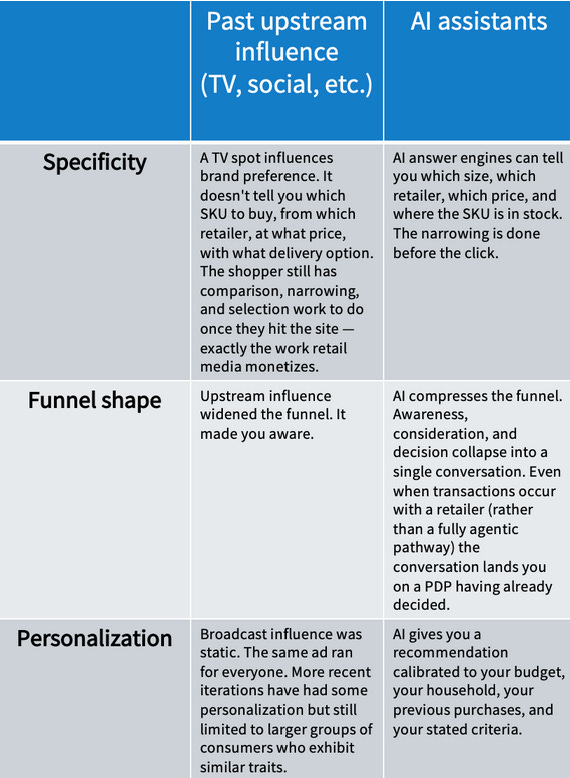
My view: none of these three is notably different from how Google search functions today (or how it will going forward with the recent UI redesign).
Specificity – Google product search already provides retailer, price, and availability data when prompted.
Funnel Shape – AI has the potential to compress the funnel (as I wrote in The Collapsible Funnel: Part 1 and Part 2) but current data indicates this is prevalent with on-site ecommerce chat tools like Rufus and Sparky. The retailer still owns the middle of the funnel.
Personalization – AI can calibrate to my budget, household criteria, and preferences much in the same way Google search does today. Do we think Google doesn’t already know all this stuff about us?
The OpenClaw Signal: Early behavior predicts mass adoption
Kiri also argues that I’m too quick to dismiss “the early behavior at the edges.”

But I’m not quick to dismiss it at all—I’ve considered it quite a bit, drawing on 20+ years of experience analyzing consumer adoption of new technologies. My assessment hinges on whether something is a use case vs. an edge case. I believe that agentic commerce (the mostly autonomous version) is an edge case reserved only for the tiny minority of tech-forward early adopter types who are willing to put in the considerable amount of work needed to execute such a purchase. (And that even they will eventually lose interest.)
“Use cases” manifest, and subsequently gain adoption, when they either provide a major improvement vs. the status quo or enough of a consumer benefit on a consistent, habitual basis. All of this weighed against realistic hurdles to adoption. And because inertia is a powerful force, the average consumer rarely invests meaningful time to develop a new behavior. (Early-days Google became a habit, for example, because the Page Rank algorithm created a step change improvement in search result quality and the minimalist homepage was drop-dead easy to use.)
Kiri cites Andrea Leigh’s attempt to automate her grocery shopping with ChatGPT as a current edge-case scenario.
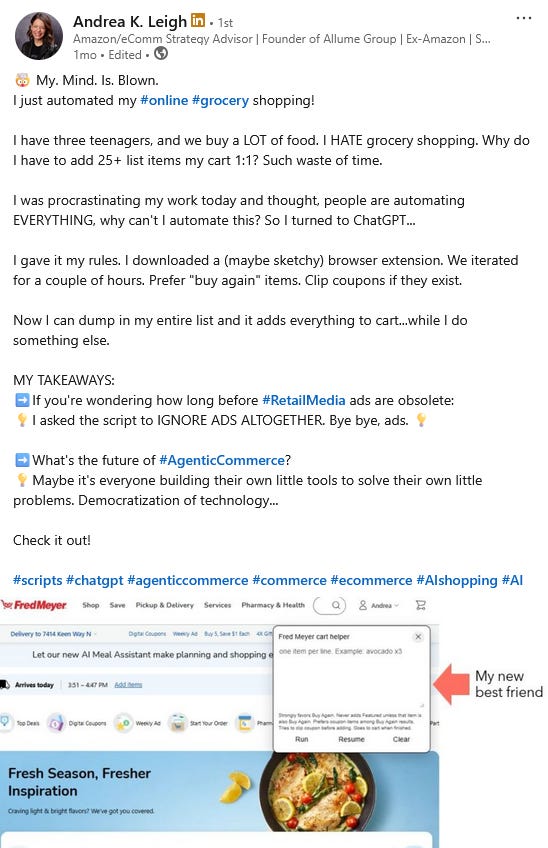
Kudos to Andrea for building this tool. I’m impressed, and it’s way beyond my capacity.
But has it really solved a big enough or frequent enough problem?
The identified pain point is adding 25+ items to the grocery cart 1 by 1.
First, Instacart and other online grocers have an easy way to repopulate your shopping cart based on previous orders.
Second, building in your preferences (a non-trivial task in and of itself) often won’t yield the best product choice.
Even if you indicate a preference for organic, gluten-free, or low sodium products, your preferences don’t universally apply and with the same prioritization for every product. They are context-dependent. For example, I prefer whole grain products for bread, not for pasta. And I prefer white bread over wheat if it’s a baguette or hamburger bun.
Finally, the biggest pain point for most people—generating the list of what to buy in the first place—isn’t addressed by the solution.
The technology is cool, no doubt. But what determines adoption isn’t how cool the technology is, but rather how useful it is to the consumer.
Kiri finally punctuates her argument:
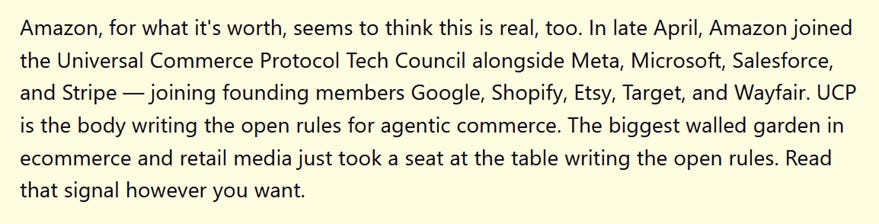
Amazon also invested billions in voice commerce, which consumers didn’t adopt. Walmart was a launch partner for Instant Checkout… which consumers didn’t adopt. Facebook changed its name to Meta as part of its massive bet on the Metaverse… which consumers didn’t adopt. I think you get the idea.
Let’s stop pretending these companies are infallible forecasters of the future.
As I wrote in my original article:
Nearly all tech prediction misfires commit the same error: they assume a future according to what a technology is (theoretically) able to do vs. how consumers are likely to interact with a technology on a regular basis. We over-attribute the tech and under-attribute the human in the equation.
If you want to know why the tech industry is hyping a new technology, follow the money. If you want to reality check that hype, follow the consumer behavior.
Who’s Hallucinating? That’s the real question
Kiri concludes her piece with a closing argument:
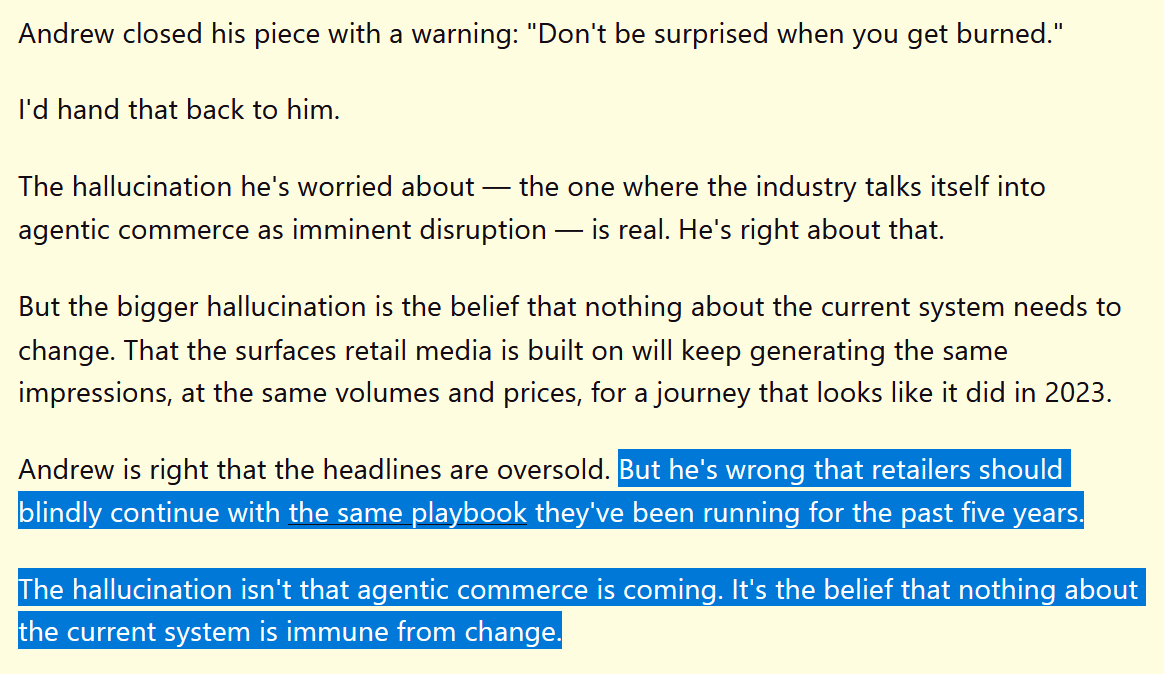
It’s a solid closing argument, if only it characterized my actual position. (Straw Man #3)
I’ve never said retailers shouldn’t evolve as AI-assisted shopping evolves. I’ve never said their paid search teams shouldn’t learn AEO/GEO.
I’ve also never argued that retailers should continue with the same playbook in the age of AI. This common misread of my argument—and one that the pro-agentic side seems to have taken particular offense—comes from my statement that “RMNs Shouldn’t Waste a Single Moment Preparing for this ‘Threat’”.
I don’t think agentic commerce is a “threat” any more than emerging channels before it have been a threat. Even the ones that actually grew into something, like mobile commerce or social commerce. In fact, those have been much bigger opportunities for retailers than threats.
Kiri finally admits I’m right that the industry is hallucinating about the “imminent disruption” of agentic commerce. Wherever might they have gotten that idea???
So, I guess I agree with Kiri that we should have a more tempered view of agentic commerce. Even under the most generous definition of the term, it is an evolution, not a revolution.
To summarize:
It’s barely a blip on retailers’ referral traffic. GenAI is still only ~0.6% of inbound referral to top retailer sites.
Dependence on GenAI referral is unlikely to accelerate with ChatGPT usage flatlining. Total US sessions for ChatGPT is actually down slightly vs. July 2025.
There’s no evidence of it siphoning traffic upstream. Top retailers continue to see traffic growth.
It’s not disintermediating ecommerce transactions. OpenAI has already walked away from the much-hyped Instant Checkout feature, with Walmart confirming adoption and conversion rates were low.
It’s not slowing down the growth of retail media advertising. Amazon Ads (+24%), Walmart Connect (+46%), Target Roundel (+35%), and Instacart (+16%) all continue to post impressive year-over-year growth rates, per most recently available public data.
The facts on agentic commerce are clear. The hype remains, and has always been, speculation without a foundation.
It’s time to stop praying at the altar of our robot overlords and get back to living life in the real world. Where human interaction with technology—and not technology itself—determines the future.
When you construct your argument on a straw man, don’t be surprised when it gets burned.