
Agentic Commerce is a Collective Hallucination
RMNs Shouldn't Waste a Single Moment Preparing for this "Threat"

The recent agentic commerce hype has sent retailers into a frenzy about what it means for the future of shopping, the threat of being commoditized, and the possibility of their retail media businesses getting vaporized.
Consider these recent article headlines:
“The Agentic Commerce Revolution is Here: How AI is Reshaping the Future of Shopping”
“Agentic AI is Poised to Be the Biggest Retail Disruption Since E-Commerce”
“Forget ChatGPT: Why Agentic AI is the Next Big Retail Disruption”
These articles envision a future where AI agents become the primary modality for shopping. They discuss the technology that underpins autonomous transaction. They point to Big Tech companies jumping on the agentic commerce bandwagon as evidence of its inevitability.
There’s just one minor detail they fail to properly consider: the consumer.
Before we start calling it a “revolution,” maybe we can find evidence of a single consumer engaging in an agentic purchase?
Nearly all tech prediction misfires commit the same error: they assume a future according to what a technology is (theoretically) able to do vs. how consumers are likely to interact with a technology on a regular basis.
We over-attribute the tech and under-attribute the human in the equation.

Defining Agentic Commerce
Let’s begin by defining agentic commerce, which often gets conflated with various applications of AI along the path to purchase. Here’s an AI-generated definition that aligns with my understanding of the term:
Agentic commerce is a revolutionary model of shopping where autonomous AI agents act on behalf of consumers to handle the entire buying process. These AI systems are not mere chatbots but sophisticated, proactive agents that understand user needs, search for products, compare options, negotiate prices, and complete purchases independently within user-defined parameters. They can also manage post-purchase tasks like tracking shipments and handling returns.
The first sentence captures the key premise: that agents handle the entire buying process.
Under scenarios where the path to purchase is constantly intermediated by a human feedback loop, then it’s not really agentic at all. Those scenarios are merely an evolution of the existing search, comparison shopping, and payment experiences—not the revolution we are being promised.
If we were to use a more lax definition of agentic commerce, then we reduce it to the sum of its component parts. This erodes, if not completely eradicates, the “agentic” value proposition. Plus, all of these capabilities are already addressed in some capacity.
Proactive commerce exists in the form of Subscribe & Save, which remains a marginal ecommerce behavior.
Product search has been popular since the dawn of Google, but the behavior has shifted to Amazon and other ecommerce sites over time.
Comparison shopping engines have similarly existed for 20+ years and have only declined in popularity.
Completing purchases was an historical painpoint that’s largely been resolved by auto-complete checkout flows and integration of mobile wallets like Apple Pay.
Post-purchase tracking isn’t even an issue. The most painful parts of ecommerce returns occur in the physical world, outside the scope of AI agents.
So, with the definition above in mind, here are eight reasons agentic commerce will prove to be more of a collective hallucination than reality.
Retailers Don’t Want Agentic Commerce
Every Ecommerce Hype Cycle is Wrong
What Has to Be True
Are You Feeling Lucky?
Exploding Ecommerce Return Rates
The Complexity/Competence Conundrum
AI Agents Don’t Know What They Don’t Know
Check Your Receipts
1. Retailers Don’t Want Agentic Commerce
Notwithstanding the likelihood of consumer adoption, the very premise of the technology is undermined by the lack of incentive from the largest retailers.
Eric Seufert of MobileDevMemo lays out the argument in his article, “Agentic Commerce is a Mirage”:
The fundamental flaw with “agentic commerce” or “agentic advertising” is that it violates the motivations of retail outlets to 1) control the customer relationship and 2) monetize their first-party data with advertising.
Amazon and Shopify are blocking AI agents because they want to retain ownership of discovery. This natural inclination has surfaced repeatedly in history: walled gardens operate with more attractive economics than open advertising ecosystems because first-party privileges confer such significant commercial advantages.
Retail platforms have no commercial motivation to allow third-party agents, broadly and without restriction, to browse their catalogue or to make purchases directly. If agentic commerce takes shape, it's likely to occur through narrowly-scoped, explicit partnerships that tilt in favor of the platforms.
Amazon and Shopify collectively own more than 50% of the US ecommerce market. How effective would a shopping agent be without access to so much inventory? How much confidence would shoppers put in an agent that excludes half of the ecommerce market from consideration?
There’s also a chicken-and-egg problem where in order for agentic commerce to be maximally useful, retailers will need to overhaul their site experience, product descriptions, and metadata structure for discoverability. But that’s a heavy lift, and one that retailers shouldn’t undertake unless and until agentic commerce represents a meaningful share of purchase activity.
2. Every Ecommerce Hype Cycle is Wrong
I’ve been in ecommerce for 20 years and watched a dozen supposedly revolutionary trends promising “the future of retail” come and go. I’m not saying the next big innovation isn’t possible, but the default assumption should be that anything being hyped before achieiving product-market fit isn’t likely to materialize.
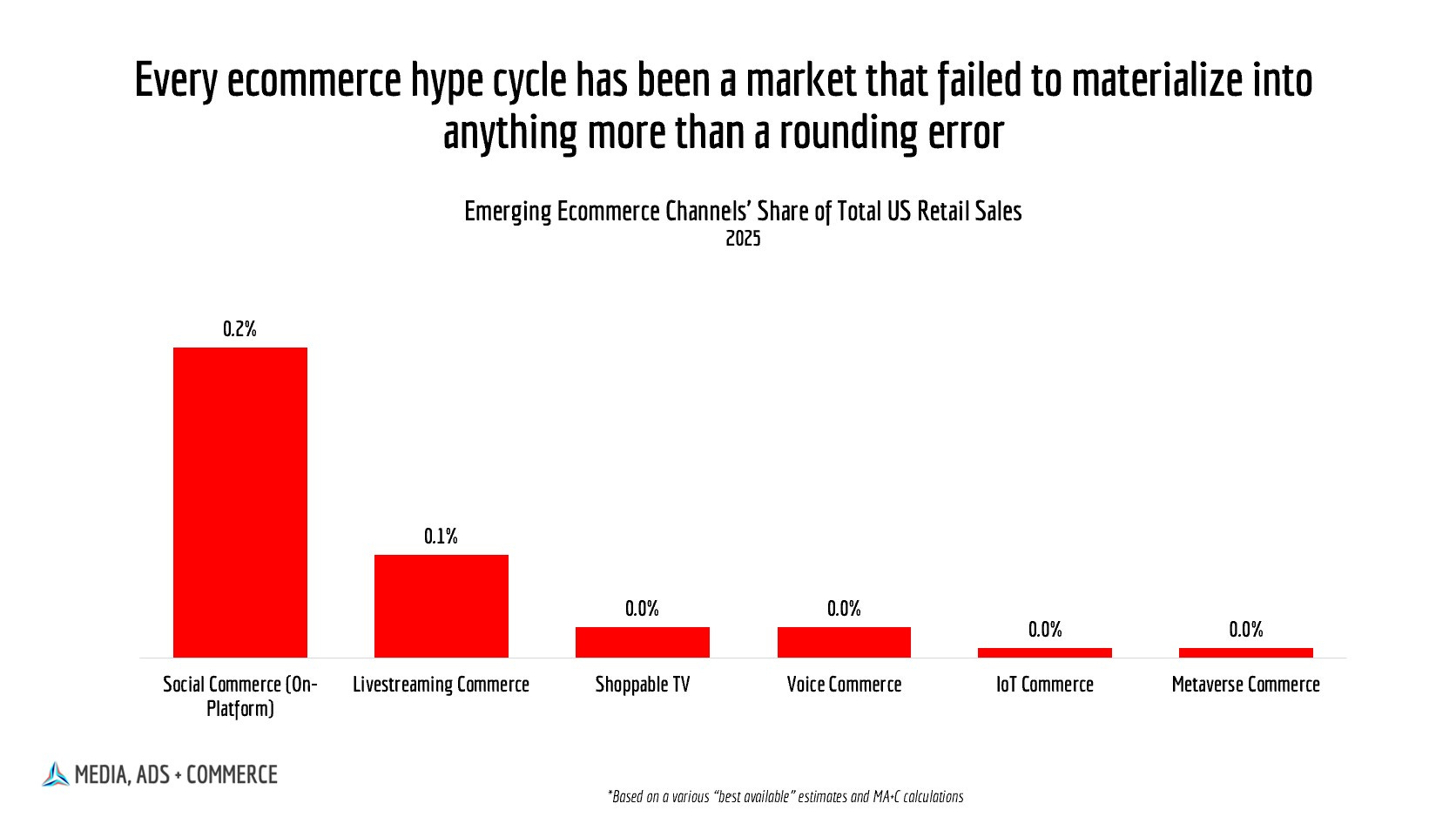
Even ecommerce itself, I would argue, has been wildly overhyped over the years. Many predictions that it would make in-store shopping obsolete sound crazy in retrospect. Nearly 30 years into its ascendance and ecommerce accounts for ~15% of US retail spending.
Here are other absurd trends we’ve been told would revolutionize retail.
Metaverse Commerce (2022) – Remember it was only a couple years ago that we all accepted our futures as avatars in the metaverse, and it would quickly take over for, y’know, living your life in the real world. Why walk down the aisles of a Walmart when you can do it in a virtual store? What a retail revolution!
Livestreaming Commerce (2019) – Analysts were convinced that livestreaming commerce—which by 2019 was amazingly a $180 billion market in China representing 10% of all ecommerce—would follow a similar trajectory in the US. One well-known retail analyst pegged the US market to hit $58 billion by 2025. It’s, um, let’s just say a fraction of that. Just because a trend works in one context, doesn’t mean it will in another.
Voice Commerce (2018) – As Amazon Echos became ubiquitous in the late 2010’s, predictions abounded that voice commerce was about to disrupt everything. Search marketers were being warned to prepare for a world in which you had to be the first search result on Alexa or you didn’t exist. You could almost cut-and-paste the arguments from then to now, with agentic commerce. Do you think brands who scrapped their existing SEO in favor of voice search optimization might regret that decision?
Shoppable TV (2016) – This trends pops up anew every few years, going all the way back to the mid-1990s with the promise of being able to “Buy Rachel from Friends’ sweater” through your TV screen. For whatever reason the media industry continues to be infatuated with the concept and just can’t let it go. Every upfronts season, another company unfurls it’s latest attempt—will it be QR codes, clickable, or voice-activated ads this time?—and the trade pubs dutifully lap it up.
IoT Commerce (2016) – Amid the Internet-of-Things (IoT) boom, we were promised a future where every device in our house would be internet-enabled and designed to anticipate our needs. Milk getting low in your fridge? No worries, you refrigerator will notice and have a new gallon sent to your door! Solution in search of a problem? Perish the thought.
How far have these trends come since their most recent hype cycle? The data on these trends are understandably sparse, but my best back-of-the-napkin calculations based on available data reveal these trends to be inconsequential.
3. What Has to Be True
A successful end-to-end agentic commerce experience requires a series of things to be true. Any broken link in the chain results in an unrealized or unsatisfactory purchase.
In the analysis below, I list as many criteria as I can that “need to be true” in order for a completed transaction to occur. Then I assigned a rough probability of each one being true.
For example, a shopper has to know how to engage with an AI agent, or a transaction will never happen. They have to be OK with giving the agent authority to spend on their behalf. They have to believe the shopping occasion demands the assistance of an agent.
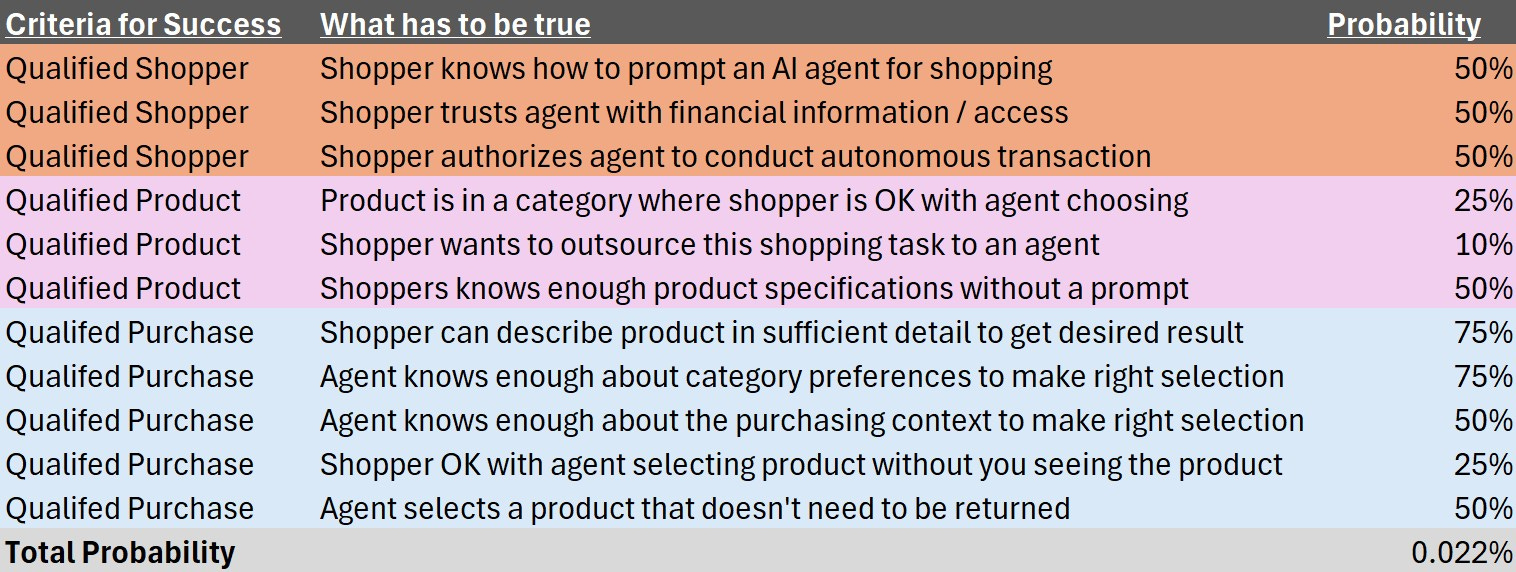
Feel free to assign your own probabilities and play with the math. It’s not about the math so much as the number of things that must be true. Whatever numbers you assign will lead to the same inevitable conclusion.
The probability of a successful agentic commerce transaction is infinitesimal.
How likely is it that a shopper will adopt agentic commerce as a new shopping modality with a low expectation for success under even the best circumstances? Habit formation is a byproduct of a positive feedback loop, and if that feedback is routinely netting a negative result, the behavior won’t catch on.
4. Are You Feeling Lucky?
Agentic commerce means giving purchasing autonomy and authority to a bot as a default. But consumers actually prefer seeing options presented before making a decision because they want to feel confident in the selection.
Remember the early Google.com homepage, which offered users two options for their search query: Google Search or I’m Feeling Lucky. The Google Search option offered the familiar search query result page of 10 or so results offering previews of where you might want to click next. The I’m Feeling Lucky option made this decision for you and automatically sent you to the website for the top listing.

In a 2006 interview with the Washington Post, Google VP Marissa Mayer revealed that less than 1% of users selected the I’m Feeling Lucky option—and the only downside of a subpar result was having to click the back button.
What percentage of consumers do we think are inclined to take a similar roll of the dice when it involves parting with their hard-earned money?
5. Exploding Ecommerce Return Rates
Apparel has an average ecommerce return rate in the mid-20% range, while other high-consideration categories like shoes, accessories, and consumer electronics are also in the double-digit range.
The economics of ecommerce are famously challenging—with the #2 player in the US Walmart only achieving ecommerce profitability earlier this year. What happens to these economics when return rates jump—and they will—as shopping and buying is outsourced to an agent?
If the economics weren’t problematic enough, there are the unavoidable negative impacts on the consumer. A CivicScience survey from 2020 found that the top pain points for ecommerce purchases all inflicted costs in time, energy, and money on the shopper—where an agent would be little to no help.
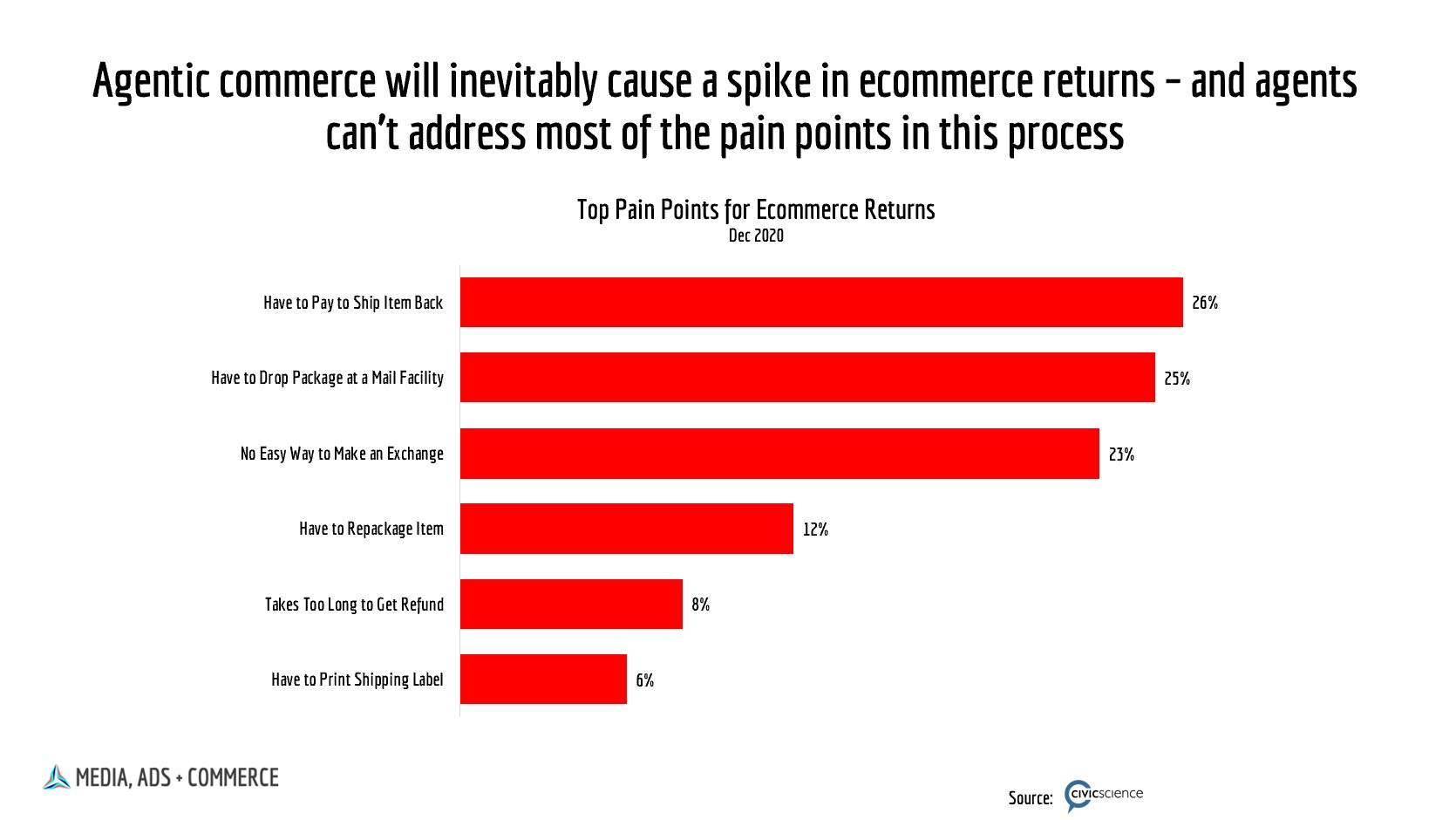
Further, consumers have little trust in platforms intermediating their ecommerce transactions. On-platform social checkout has struggled to gain traction because consumers would prefer to interact directly with the retailer, don’t trust products sold on social platforms, and don’t trust platforms with their payment information.
These companies also make speaking with live customer service difficult, if not impossible. Who wants to purchase through a company that doesn’t take accountability for the transaction?
6. The Complexity/Competence Conundrum
Agentic commerce can only exist if it solves a shopping pain point—saving time, hassle, or money—or delivers a better shopping outcome. But there is an inherent conundrum between the value of the transaction and the usefulness of the agent.
When complexity is high, an AI agent is less likely produce a good result. When complexity is low, the AI agent isn’t addressing enough of a pain point to matter.
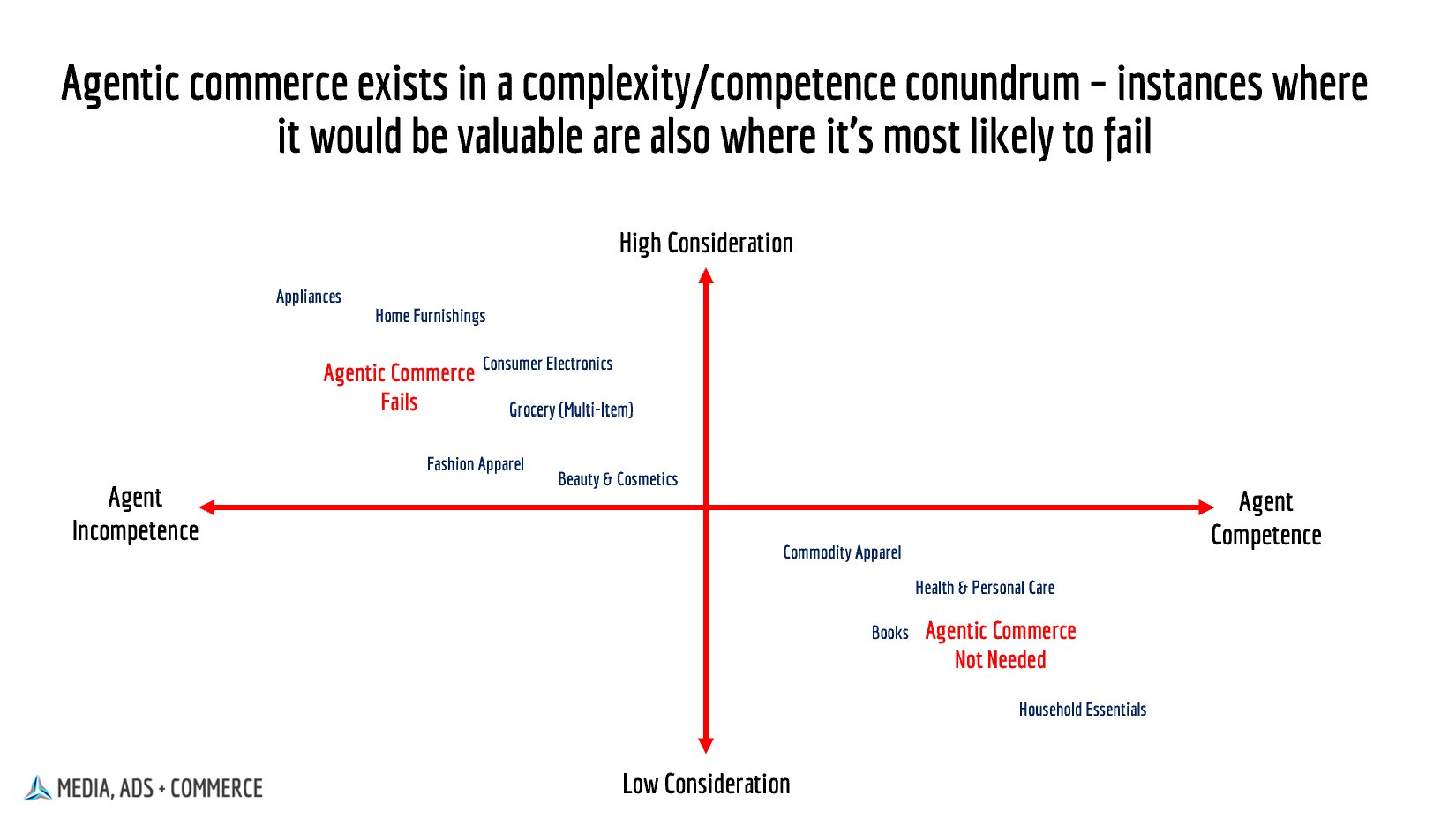
I was once shown a demo of how a shopping agent can buy a book off Amazon with a single prompt. I was unimpressed.
Why do I need an agent to do something for me that takes 1-minute and a couple of clicks on my phone? Also, what version of the book will the agent buy for me — hard cover, paperback, or Kindle? The downside of making a return far outweighs the upside of a few seconds in time-savings.
On the other end of the spectrum, how confident do I feel about giving an agent access to my wallet to spend a couple thousand dollars on a new suit, or couch, or laptop of its choosing?
Examples abound of purchase occasions that agentic commerce would supposedly be great for. But they never consider the potential points of failure.
An oft-cited example is buying groceries, which was referenced by Paypal CEO Alex Chriss in a Linkedin post:
“Imagine Sarah, a working mother of three who dreads Sunday nights—not because Monday is coming, but because she hasn't planned the week's meals yet. Between soccer practice, client calls, and helping with homework, meal planning often falls through the cracks, so Sarah is faced with making another late-night grocery run or ordering takeout yet again.
Now imagine Sarah simply telling her AI agent between client calls: "Plan healthy meals for next week based on the meals we’ve made in the past, accommodate Jake's peanut allergy, and keep grocery costs under $150." An agent then instantly creates a meal plan, and schedules delivery for Tuesday when Sarah is working from home.”
OK, at least in this instance there’s a real-world problem to be solved. But let’s consider how reality might play out.
Sarah gets a list of 5 healthy dinner meals suitable for children’s tastes. The groceries arrive at her doorstep on Tuesday. The groceries include 10 different ingredients that are already fully stocked in her pantry and fridge, including a new gallon of milk when she already has a near-full gallon. Time to clean out the fridge to make some space!
The agent’s version of “healthy” includes low-fat milk, yogurt, and cheese even though Sarah believes full-fat dairy is healthier. She makes the dinners on the menu for the week, but each of her kids complains and refuses to eat at least a couple of the meals.
Oh yeah, and poor Jake ends up in the emergency room because one of the ingredients wasn’t produced in a nut-free facility.
7. AI Agents Don’t Know What They Don’t Know
For AI shopping agents to be any good, they need to know a lot about the shopper. This requires a considerable upfront investment from the consumer to provide user-level access to ecommerce sites, loyalty programs, bank accounts, and/or browsing histories. In addition to data privacy and security concerns, it’s simply a big ask of the consumer.
Even under the most optimal circumstances, when an AI agent knows an incredible amount about your existing purchase patterns, favored brands, household income, etc., how well equipped is it to make a buying decision on your behalf?
The most important variable for many purchases isn’t behavioral, but contextual. That could mean the occasion, physical location, emotional state, sense of urgency, or any other number of factors that make you decide to buy Product A vs. Product B in that moment.
Maybe a shopper includes that contextual factor in the prompt, but a lot of times its influence is subtle and doesn’t register consciously. Even when it does, the agent many not know how to weigh that variable against others.
If a shopping agent’s job is to “predict” the best purchase for you based on what it knows, how often will it arrive at the best option when it lacks your most important purchase criteria?
8. Check Your Receipts
Agentic commerce advocates will talk in high-minded terms about all the shopping occasions suddenly made easy. But how well does the theory stand up to reality?
In real life, purchases are often mundane. And judging by my actual recent purchase history, I can’t see a single instance where an AI agent would represent a material improvement in outcome or time-savings.
Here are the last five products I searched for, and what I actually ended up buying:

The instances where an agent might end up in the same place as me—the basketball pump and the Claritin—were by far my easiest transactions. Almost no thought required.
The rest of the instances, I’m certain an agent would end up with a sub-optimal outcome. A single Blue V-Neck Shirt. A pair of OnClouds I’m ambivalent about. A compost bin by any other brand than OXO.
A Final Challenge
With all that said, I’d like to offer a challenge.
If you believe in the power and inevitability of agentic commerce, then use it for your next 5 purchases and let me know how it goes.
Want to raise the stakes? Do it for a $100+ purchase, or for a gift for somebody you care about.
If you’re not willing to do that, ask yourself why not?
I think you're right that the "hand over my credit card to an AI" vision is likely a collective hallucination, but I wonder if we're framing the question wrong. The most interesting use case for AI in commerce isn't replacing human decision-making entirely - it's augmenting the tedious parts while keeping humans in control of actual purchases.
I've been building an AI agent (Wiz, using Claude Code) and what strikes me is how much value there is in the research and comparison phase alone. Having an agent that can scan reviews, compare specs, track prices, and present options is genuinely useful. But do I want it clicking "buy" autonomously? Not really - and I built the thing.
Your point about Amazon and Shopify having no incentive to support this is spot on. The platforms that control checkout control the relationship. Why would they cede that to an intermediary? The economics simply don't work for them.
Where I slightly diverge is on the long-term trajectory. I don't think agentic commerce dies entirely - I think it evolves into something more constrained and practical. Agents handling reorders of known products, managing subscriptions, or executing pre-approved purchases within set parameters. Less "autonomous shopper," more "smart purchasing assistant with guardrails."
I wrote up some related thoughts on where agentic commerce might actually land vs. the hype: https://thoughts.jock.pl/p/agentic-commerce-ai-shopping-for-you-2026
Andrew — six months on, this piece has aged remarkably well. The ACES paper from Columbia/Yale (Allouah et al., 2025) now provides the causal data behind what you argued here from a consumer-behavior lens. Their randomized experiments show sponsored tags reduce agent selection probability by 11-21% across Claude, GPT-4.1, and Gemini. The agents actively penalize sponsored content — not just ignore it.
Since you wrote this in September, the industry visibly split: OpenAI launched ChatGPT ads (Feb 9, 2026), Anthropic bet $8M+ on a Super Bowl anti-ad campaign (Feb 8), and Perplexity abandoned advertising entirely. Five models are now competing to replace the $650B ecosystem — and your "collective hallucination" framing is still the strongest counter-argument to the hype.
I wrote a follow-up mapping all five models. Your work is cited as the leading skeptical voice: https://findcraft.uk/blog/ai-agents-penalise-sponsored-content/