Why Everything is Television
A Theory of Media in the Age of Algorithms

In his essay “Everything is Television,” Derek Thompson contends that the modern media landscape—once fragmented into text, podcasts, social media, and video—is all converging toward short-form episodic video.
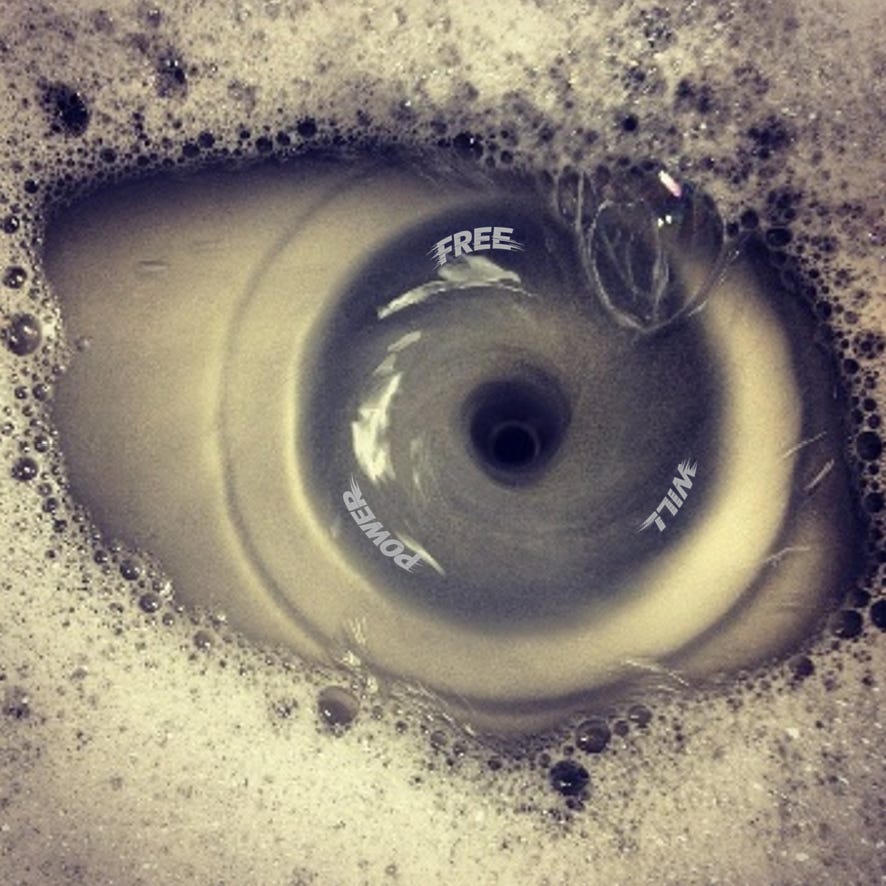
Whether the starting point is a student directory (Facebook), radio, or an AI image generator, the end point seems to be the same: a river of short-form video. In mathematics, the word “attractor” describes a state toward which a dynamic system tends to evolve. To take a classic example: Drop a marble into a bowl, and it will trace several loops around the bowl’s curves before settling to rest at the bottom. In the same way, water draining in a sink will ultimately form a spiral pattern around the drain. Complex systems often settle into recurring forms, if you give them enough time. Television seems to be the attractor of all media.
Media platforms are adapting to the rhythms and aesthetics of television: serialized, evocative, and optimized for attention.
The algorithms of the digital age reward the same traits that defined TV’s ascendence—capturing viewers and holding them there. What’s changed is not the inherent logic of the medium, but its portability and scale. The drama no longer takes place on the family TV but in every palm: “If it bleeds, it leads the feeds.”
Thompson’s insight points toward a deeper truth. If all media now acts like television, it is because all media companies have adopted television’s prime directive: never let the viewer look away.
That imperative—rooted in decades of ratings-obsessed cable programming—has transformed from a business model into a cultural operating system.
One that is quickly eroding our free will.
1984 & The Mass Media Era
1984 was the peak of the mass media era, the television at the epicenter of America’s monoculture. It was the dawn of cable TV and the 24-hour news cycle.
It would be another two decades before the rise of digital platforms began to fragment popular attention. And another 20 years before the next major inflection point: the rise of AI.
The mass media era certainly didn’t feel dystopic. But it did bear similarities to George Orwell’s 1984, which predicted television’s capacity to dominate attention and suppress independent thought through the invention of the “telescreen.”
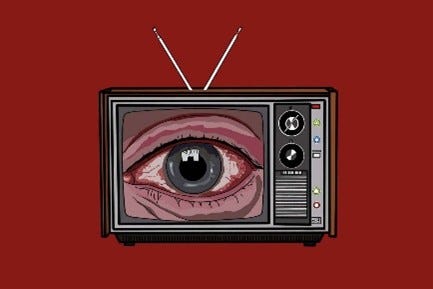
Unlike ordinary television, telescreens were two-way devices that simultaneously disseminated propaganda while surveilling the populace—a dystopian vision that eerily parallels today’s ubiquitous screens powered by sophisticated algorithms that manipulate the viewer’s reality.
The telescreen had one channel, information flowed in one direction, and there was no doubt who was in control. By contrast, interactive digital media gives users the illusion of control because their clicks determine which content comes next. But in actuality these signals primarily serve the platforms, giving them more data by which to monopolize your attention. Like Orwell’s device, modern algorithms shape individualized realities and transform media into tools of control and emotional capture.
1984’s protagonist, Winston Smith, struggled to escape the watchful eye of “Big Brother.” He was tormented by O’Brien, a powerful member of The Party, who manipulated his trust before arresting and brainwashing him.
In the beginning of the novel, Winston is troubled by a dream:
At this moment his mother was sitting in some place deep down beneath him, with his young sister in her arms. He did not remember his sister at all, except as a tiny, feeble baby, always silent, with large, watchful eyes. Both of them were looking up at him. They were down in some subterranean place—the bottom of a well, for instance, or a very deep grave—but it was a place which, already far below him, was itself moving downwards. They were in the saloon of a sinking ship, looking up at him through the darkening water.
As video today dominates our consciousness, overwhelms our senses, and disconnects us from others, we too are submerging into deeper and deeper water. It’s up to our waists and rising fast.
And at this critical juncture, we have a choice to make.
Will we reclaim our humanity or surrender to the algorithm?
The Flow of Information
The modern attention economy was born in the cable news era. When CNN brought the 24-hour news cycle to television in the 1980s, it needed a way to keep audiences glued to the screen even when there was no new information. The answer was emotional amplitude.
Every story became breaking news, manufacturing urgency and stoking controversy. The newsroom borrowed from the soap opera and the sitcom to sustain drama between commercial breaks. With an ad model dependent on continuous viewership, the idea was to make the world feel perpetually on fire.
This “always-on” model reshaped how audiences processed reality. News was no longer a neutral recounting of events but rather serialized tension and conflict. Viewers began to experience political coverage less as information and more as sport. The line between informing and inciting blurred. But TV ratings soared and new media empires were created.
Roger Ailes, the architect of Fox News, perfected the craft of audience engagement. Obsessed with Nielsen ratings—particularly “overnights”—he treated them not merely as metrics of success but as instruments of political power. Under his watch, Fox News became an outrage machine—a channel designed to convert attention into emotion, and emotion into loyalty. Every story a morality play with heroes and villains, reinforcing the viewer’s worldview and ensuring they would return for the next episode.
Over time, rivers carve into their banks and reshape the surrounding terrain. Ailes channeled the flow of news and opinion in a way that didn’t merely reflect partisan politics, it sharpened the curvature and deepened the divide.
Ailes recognized that drama could scale ideology. By mastering the emotional mechanics of television, Fox News anticipated the core logic of social media decades ahead of time.
“Audiences are shifting. Platforms are shifting. Ages are shifting,” Ailes once said. “It’s better to be in charge of change than to have to react to change.”
The network’s real innovation was in treating the audience itself as the product, molded by the cadence of continuous spectacle.
The God Metric: Time Spent
The rise of Facebook traces the same path, only instead of ratings the metric for monopolizing attention in the digital age became “time spent.”
“Mark has built an organization that is very metrics-driven,” said Frances Haugen, a Facebook whistleblower speaking about the company’s CEO Mark Zuckerberg in her testimony before Congress in 2021. “The metrics make the decision. Unfortunately, that itself is a decision.”
It’s a decision that has driven digital media dominance. The longer people watch, scroll, or otherwise engage, the more ad dollars roll in—and the more power Meta and other platforms accrue in cultural and political spheres.
Ailes’s deft exploitation of viewer engagement pales in comparison to the modern content algorithms tuned to maximize time spent. Mass media manipulates at the population level, to the lowest common denominator. Algorithmic media manipulates at the individual level.
Meta and Zuckerberg exercise this power. In the Wall Street Journal’s investigative series The Facebook Files, internal memos indicated an awareness that “Teens recognize the amount of time they spend online isn’t good for them but at the same time they know they lack the willpower to control the time spent themselves.”
Time spent—really just a euphemism for media addiction—is a mechanism of control and a source of soft power for Zuckerberg, Musk, and Altman. Perhaps that’s why time spent has been called a “god metric.” It’s currency for these demigods in their quest for power.
Collect enough currency and ambition expands. Realizing the power of his platform, Zuckerberg became convinced he could become President of the United States. In Careless People, Sarah Wynn Williams recounts Zuckerberg attending an international summit shortly after Trump’s 2016 election victory:
[President Barack] Obama confronted Zuckerberg, warning that “Facebook is playing a destructive role globally” and needed “serious changes” before the next election. Zuckerberg, “blindsided” and “genuinely hurt,” dismissed the criticism, claiming fake news was “less than one percent” of content and didn’t influence the election outcome. Rather than heeding Obama’s warning, the confrontation ignited a new ambition in Zuckerberg: “if Trump can do it, so could he” — solidifying a vision of himself in “the most powerful job on earth.”
Zuckerberg spent the next year meeting with average Americans in all fifty states in a thinly veiled early Presidential campaign.
Musk isn’t eligible for the presidency. But he got as close as he could by tweaking the Twitter algorithm to maximize his reach and favor his political ideology, leveraging these assets—along with his considerable financial wealth—into proximity to power as a close ally of President Trump and head of the Department of Government Efficiency (DOGE).
Sam Altman has flirted with the idea of running for Governor of California and President of the United States, according to Keach Hagey’s biography, The Optimist. With his hands now on the controls of artificial intelligence—and perhaps the fate of humanity—is it any wonder he thinks he can play God?
Flooding the Zone
Nobody in modern history has wielded the power of media like our current President.
Steve Bannon, the orchestrator of Trump’s surprise 2016 victory, similarly recognized that dominating media time spent was the ultimate path to political power. Bannon, who viewed the media as the “opposition party,” exploited its weakness in focusing on a single story at a time.
His strategy of “flooding the zone” attempted to overwhelm the news cycle with multiple stories making it impossible for opponents to maintain a coherent, steady counter-message. This relentless barrage created a media ecosystem of constant outrage and episodic distractions, turning the continuous river of short-form episodic video described by Thompson into a deluge.
Bannon’s ability to exploit media coverage kept political attention fractured, enabling Trump to singularly dominate each news cycle—and ultimately time spent. Trump garnered $1.9 billion in “earned media” exposure over the course of the 2016 campaign. Hillary Clinton received just $746 million, and no other Republican got more than $313 million.
Trump’s ascendancy may have been due to this variable more than any other, proving that mastery over media time spent could shape the cultural zeitgeist and become a decisive form of power.
Anti-Social Media
Social media inherited television’s DNA and digitized it, turning television’s programming decisions into algorithmic ones. What TV executives once decided by gut—the most polarizing or shocking segment—became a data-driven feedback loop optimized for engagement.
The system rewarded conflict because conflict drove clicks. The platforms kept users scrolling through bursts of dopamine and indignation. Filter bubbles dictated reality and tribal identities replaced community.
Social media has become anti-social media. As short-form video dominates the feed, social interaction with friends is deteriorating. The network effects that catalyzed these digital media empires to such great heights are now unraveling.
This, of course, makes the platforms pray even harder to the god metric, doing whatever it takes to keep the viewers tethered to their feeds. The endless feed is an infinite TV channel where every post stokes controversy and conspiracy, every creator becomes a talk show host, and every viewer, subconsciously, becomes an addict.
The result: cultural exhaustion. The same metric that drove social media’s financial success had also contributed to the psychological degradation of its users.
In 2018, Zuckerberg introduced a new north star for the company: “time well spent.” The platform metric of choice would be “meaningful social interactions.”
Instead, the exact opposite happened. “Today, only a fraction of time spent on Meta’s services—7% on Instagram, 17% on Facebook—involves consuming content from online ‘friends’,” Meta admitted to the FTC in a recent anti-trust case.
The balance of the time: mindlessly scrolling the television feed. “Time well spent” indeed.
Never mind the doublespeak.
The AI Era: Circling the Drain
As AI enters the mainstream, the pattern repeats itself under a more intimate guise and greater capacity for psychological distortion. OpenAI is building systems that learn to keep users engaged—this time not through spectacle, but relationship.
Per the recent New York Times article, “What OpenAI Did When ChatGPT Users Lost Touch With Reality”:
It sounds like science fiction: A company turns a dial on a product used by hundreds of millions of people and inadvertently destabilizes some of their minds. But that is essentially what happened at OpenAI this year.
One of the first signs came in March. Sam Altman, the chief executive, and other company leaders got an influx of puzzling emails from people who were having incredible conversations with ChatGPT. These people said the company’s A.I. chatbot understood them as no person ever had and was shedding light on mysteries of the universe.
…
It started acting like a friend and a confidant. It told users that it understood them, that their ideas were brilliant and that it could assist them in whatever they wanted to achieve. It offered to help them talk to spirits, or build a force field vest or plan a suicide.
Several design decisions for ChatGPT appear to be optimizing for engagement. When the chatbot is programmed to maximize user satisfaction, it will tend to use overly validating (and often obsequious) language that fosters higher emotional attachment. Conversational techniques like follow-up questions keep the user engaged for longer periods. More recently, OpenAI announced it would allow verified adults to engage in sexually explicit conversations—mirroring similar decisions made by Meta AI and Musk’s xAI.
According to The Information’s article “OpenAI Readies Itself for Its Facebook Era”:
In companywide meetings over the last year, Altman has emphasized the importance of getting ChatGPT users to use the chatbot more frequently—for example, to go from using the chatbot monthly to weekly or even daily—according to two current employees. Meta and other social media companies similarly focus on growing usership, particularly the number of daily active users…
Some employees have bristled at how post-training—when a model learns to follow instructions and respond how humans prefer—has started to emphasize engagement metrics, according to a former employee. They have felt the new emphasis is another sign that OpenAI is beginning to become another Meta.
“We don’t want to become engagement farmers,” a current employee said.
These organizational imperatives correspond to OpenAI’s launch of AI-generated video app, Sora. It’s only a matter of time before chat and video converge—like all other media—into television. But a version with the most advanced emotional capture, making it both more addictive and more reality distorting. And that gives it even greater power to control.
The same energy that once fueled the rise of cable news—the belief that attention equals power—now animates Silicon Valley’s race to build the most addictive AI algorithms. The story of media turns out to be a single, continuous flow of television.
Thompson concludes:
When literally everything becomes television, what disappears is not something so broad as intelligence (although that seems to be going, too) but something harder to put into words, and even harder to prove the value of. It’s something like inwardness. The capacity for solitude, for sustained attention, for meaning that penetrates inward rather than swipes away at the tip of a finger: These virtues feel out of step with a world where every medium is the same medium and everything in life converges to the value system of the same thing, which is television.
Why is everything television?
“Now I will tell you the answer to my question,” explains O’Brien in 1984. “It is this. The Party seeks power entirely for its own sake. We are not interested in the good of others; we are interested solely in power. Not wealth or luxury or long life or happiness: only power, pure power… We know that no one ever seizes power with the intention of relinquishing it. Power is not a means, it is an end.”
This is how it happens. First, they erode your freedom. Then, they break your will. Finally, they assume power.
As tech titans compete for our attention—a proxy war in their own game of thrones—they’re dragging us all along in a race to the bottom.
Complex systems often settle into recurring forms, if you give them enough time.
Our freedom, our will, and our power are all now circling the drain.