
Performance TV is Television’s Third Big Wave: Part 1
Can RMNs Get CMOs to Ride the Retail Media Wave Without Wiping Out?

The biggest headline coming out of Cannes this year was Amazon’s streaming TV partnerships with Disney+ and Roku. For a tech company that once awkwardly navigated media circles, Amazon has recently emerged as the star of the croisette.
Amazon Port—an elaborate display presiding over the row of beachfront activations—stood as a monument to the company’s ascendance among the ad industry elite. Its 15-foot walls were adorned with floral vines as if to assert, in a literal sense, Amazon Ads’ status as a walled garden.
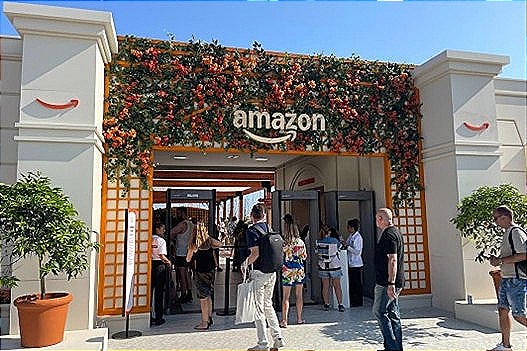
Or is it a hedged garden?
Perhaps the latter description is more accurate with the tech titan’s growing number of media partnerships, including with its most direct advertising competition.
With these two streaming TV advertising heavyweights in tow—plus NBA games coming to Prime Video in the Fall—Amazon boasts the most premium inventory and access to ~30% of the CTV ad market.

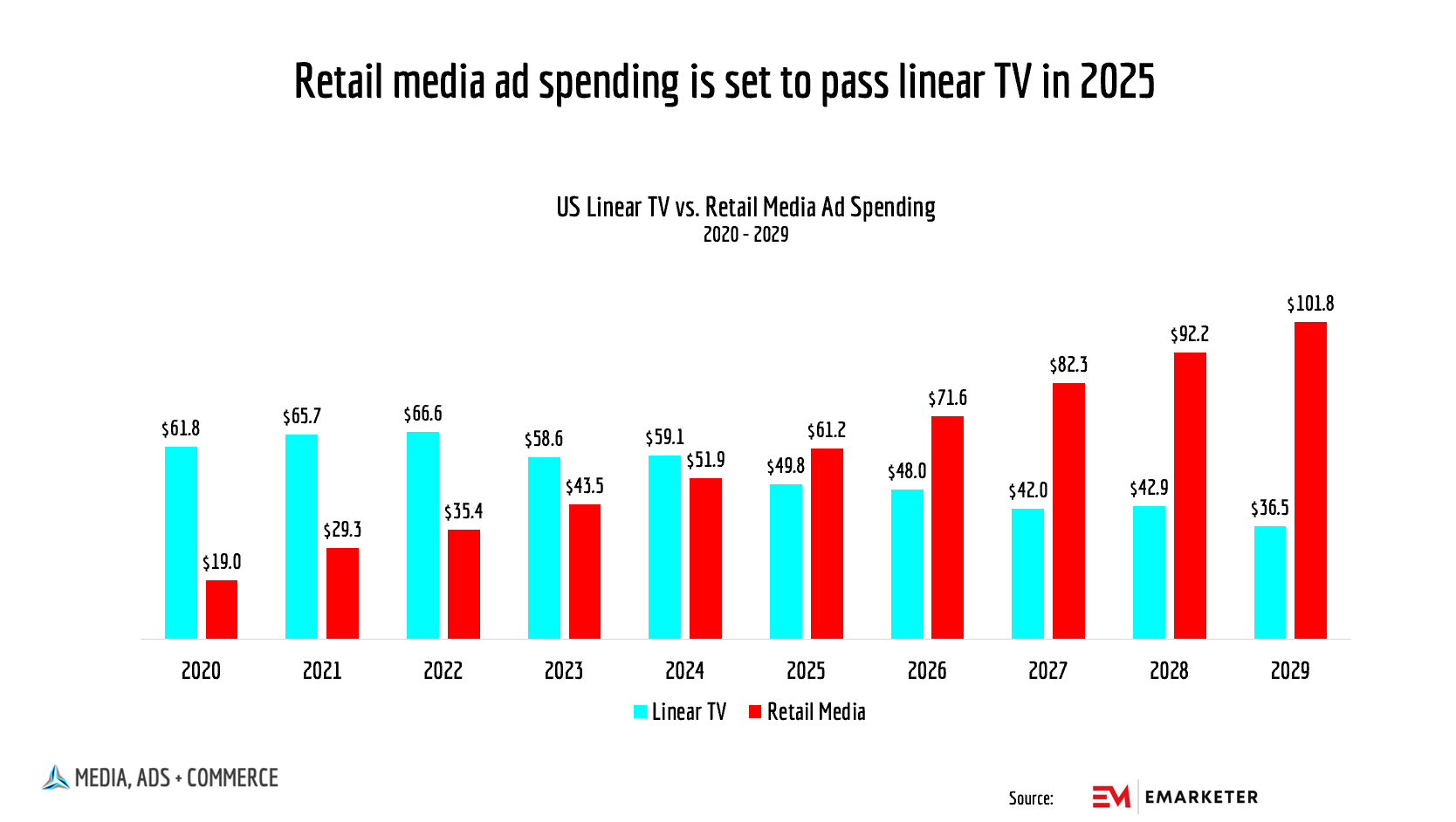
If CMOs were trying to ignore retail media, they can’t any longer. In fact, the sector is set to pass CMOs’ favorite media channel—linear TV—for the first time this year, according to EMARKETER.
Amazon’s dominance is growing among RMNs in the CTV space, but Walmart Connect is trying to keep pace. The 2024 Vizio acquisition gave the fast-growing ad business a foothold in the streaming TV ad market and full-funnel capabilities that match Amazon’s in structure if not in scale.
Ryan Mayward, SVP of Sales at Walmart Connect, described the RMN’s ambition to Mike Shields of Next in Media:
“Walmart Connect started with the largest brands in the world, and we’ve since built out a very large business working with small to medium-sized brands and third-party sellers… The big barrier to entry, or one of them in the TV realm [for these kinds of brands has been TV creative]. We also have an opportunity to just solve that on their behalf through AI-enabled creative tools. We’re building out our creative stack now. We’re starting with display but we’ll soon move to video. And you’ll see smaller brands have an easier path to advertising on TV.”
Mayward’s last comment is the key for Walmart Connect, Amazon Ads, and all RMNs entering the streaming TV space. The market’s growth will be powered by mid- and long-tail advertisers, many of which have never advertised on TV screens before.
Previously excluded from a TV ad market requiring creative production teams and six-figure campaign budgets, these advertisers no longer have the same barriers to entry. Plus, they speak the language of performance advertising.
Performance TV is Television’s Third Big Wave
We are now approaching the inflection point for television’s third big wave: Performance TV.
The first big wave was Linear TV, which was predicated on broad reach. The second big wave was CTV, which delivered addressable audiences to advertisers. Performance TV now emerges as the third big wave, introducing closed-loop targeting and attribution to what’s historically been “the least measurable medium.”
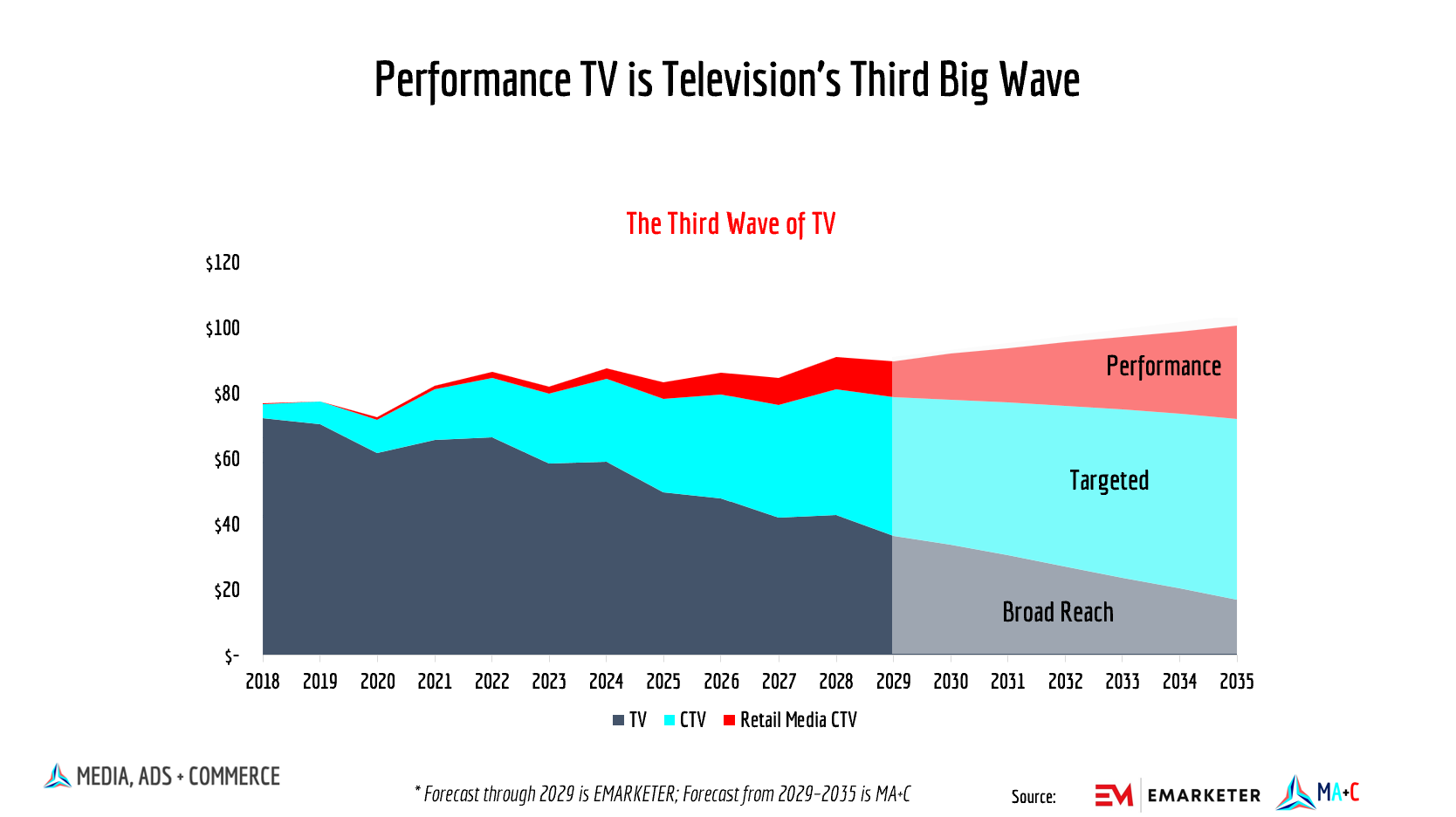
As retail media is evolving up the funnel, TV advertising is evolving down the funnel. During the linear TV era, advertisers sought to reach mass audiences across a handful of national broadcast networks, with Nielsen TV ratings and gross rating points (GRPs) as the primary basis of measurement. The streaming TV era introduced advanced audience targeting as several upstart Nielsen competitors promised more granular campaign measurement.
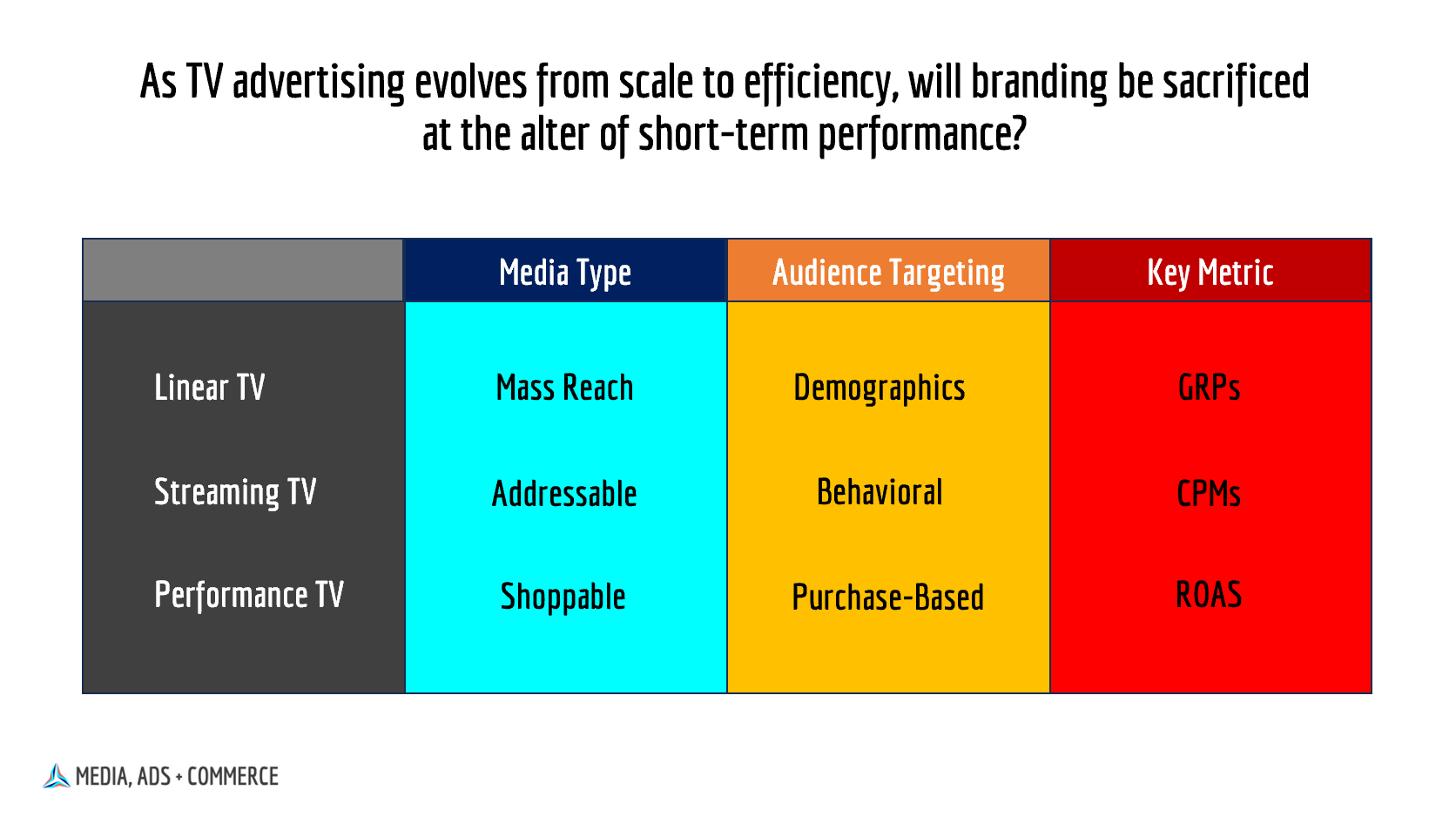
With its foundation of closed-loop targeting and attribution, Performance TV is flipping measurement on its head. Outcomes are the new currency, and ROAS is the primary metric. This framework familiar to digital advertisers stands to massively disrupt TV advertising—and not necessarily for the better.
In Part 1 of this article, we’ll explore three ways RMNs risk squandering their Performance TV mega-opportunity by focusing too narrowly on performance. In Part 2, we’ll examine the potential landmines for RMNs as they court national advertisers using more traditional brand-building metrics.
How Performance TV Will Fail to Perform
Digital advertising’s original sin is optimizing to the wrong metrics. Performance advertisers place too much emphasis on the last click and bias towards that which is measurable.
Here are three performance-oriented mistakes that RMNs should aim to avoid as this next evolution of TV unfolds.
1. Using ROAS as the Primary Campaign KPI
As Performance TV becomes prominent, the focus should remain more on “TV” than “Performance.” An ad industry that’s long valued 30-second spots for creative storytelling can’t forget what makes advertising effective—and it’s not often captured in short-term attribution windows. That’s why turning ROAS into a primary KPI for evaluating Performance TV, simply because it’s the current standard in retail media, would be such a mistake.
Among the many problems with ROAS, one practical issue is that streaming TV’s premium CPMs are a drag on that metric. Brands incentivized on cost-efficiency will naturally to steer away from CTV, especially when it’s accompanied by retail media data costs. A May 2023 McKinsey study showed that brands placed CTV at the very bottom of retail media ad formats in driving ROAS.
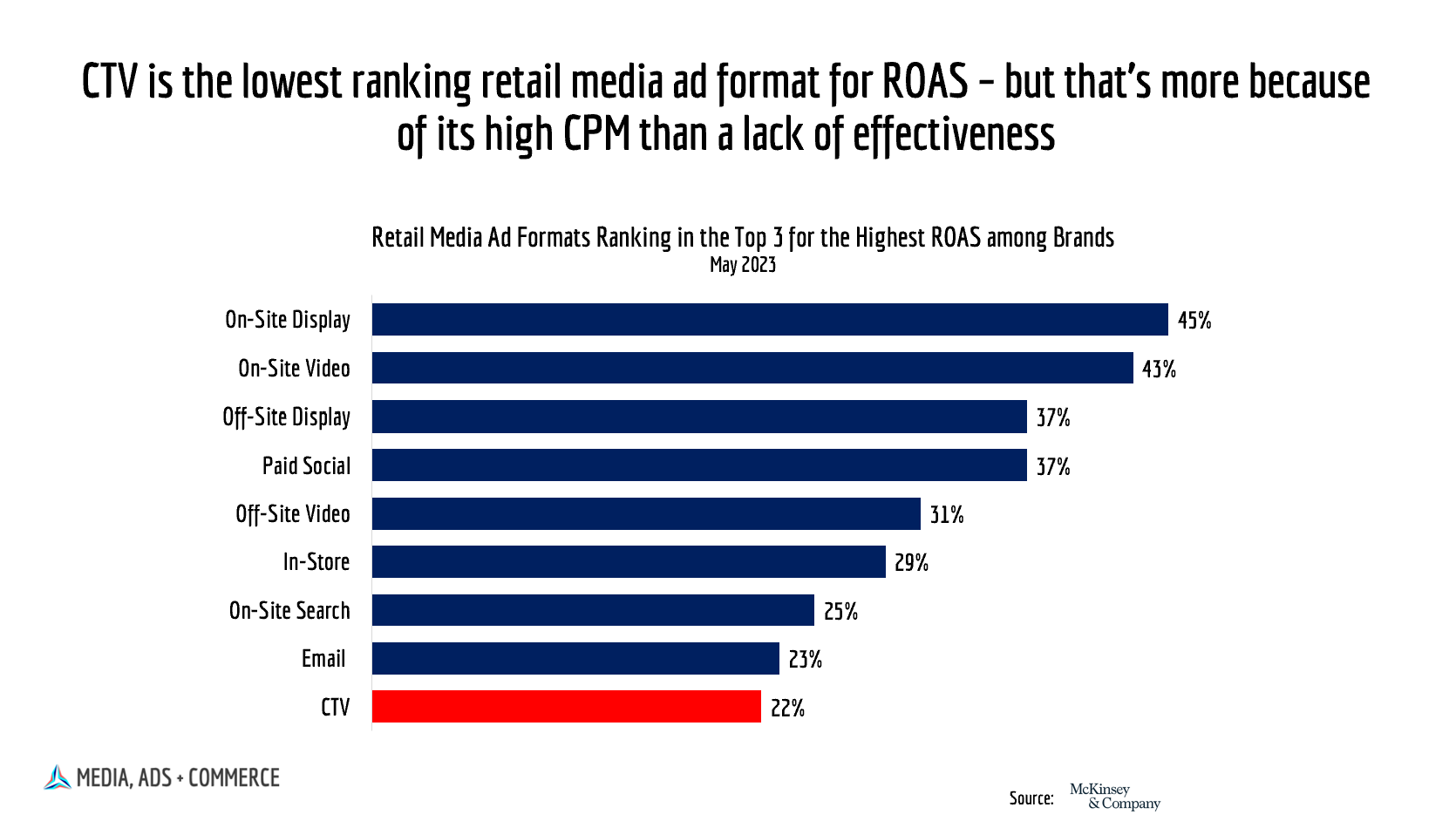
Of course, that doesn’t mean CTV is truly lower-performing. It’s just not “ROAS-friendly”. Nevertheless it’s an easy decision to cut from the media plan when brands are held accountable to that metric.
2. Combining Premium TV with Programmatic Video to Lower CPMs
A core advantage of CTV is combining it with other digital video. It allows for audience de-duplication in a way that linear TV can’t match, helping brands maximize target reach and campaign effectiveness.
But with many advertisers focused on hitting cost-efficiency KPIs, agencies will find creative ways to bring down the cost-average of campaign. Like blending high volumes of low-cost programmatic impressions to bring the CPM in line with other digital media.
Streaming TV CPMs are currently over $20, approximately 3x higher than online video, according to Guideline. To bring total video CPMs into the $10-12 range, advertisers need to allocate the majority—about 70-80%—of impressions to online video.
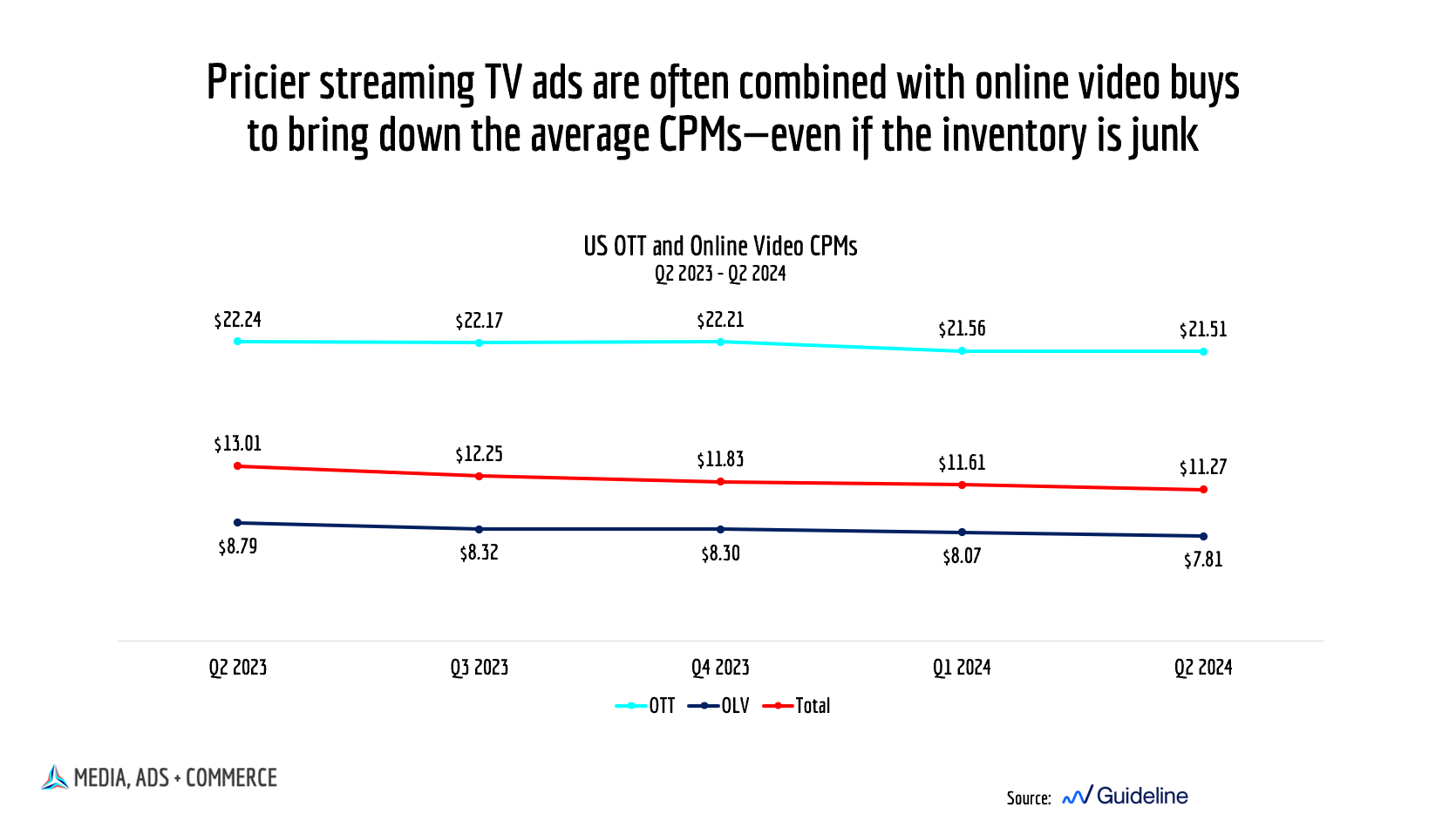
It’s basically the same scheme that caused the sub-prime housing crisis—sellers getting to maintain a premium rating on the asset even as low-grade assets diminish the quality. As these lower quality impressions lead to sub-par campaign performance, buyers will simply steer clear of that media in the future.
3. Sinking Resources into Shoppable TV
Shoppable TV has been an advertising trend on the precipice—for almost 30 years now. Every upfronts season, networks show off their latest attempt at shoppable ad units. They experiment with them during major events like the French Open or Black Friday. And they’re surprised to find out once again that viewers aren’t really interested in buying stuff on their TV screens.
Shoppable TV has understandable appeal to the advertising community given its scale and ability to bring measurable performance to TV, like click-throughs for digital ads.
The problem is that the numbers just aren’t there, especially with QR codes, according to Peter Hamilton, Head of Ad Innovation at Roku, on an episode of Next in Media with Mike Shields.
“QR codes do not perform,” said Hamilton. “I can’t be bothered to take out my phone. We see it in the response rates—it’s like .02% of people.”
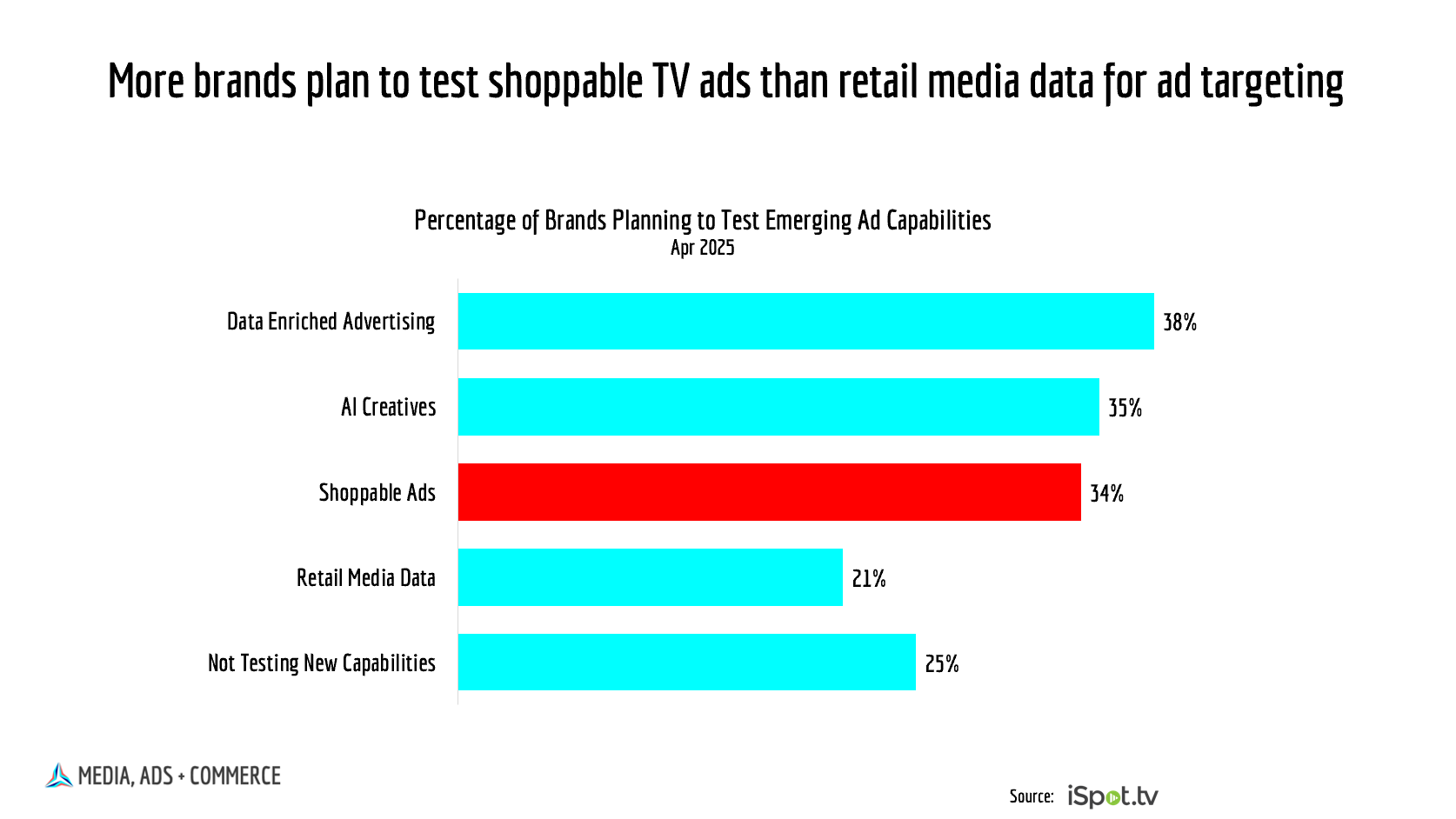
Nevertheless, advertisers continue to line up to test their latest iteration of shoppable TV ad formats. An April 2025 iSpot.TV study found that 34% of brands planned to test shoppable ads in the coming year.
Meanwhile, only 21% said they would test the use of retail media data for ad targeting! It’s crazy that advertisers’ desire for clickable TV ads is so great they’ll deprioritize ad targeting solutions that actually work.
In Part 2, we’ll explore how weak management of Performance TV’s branding effects can cause similar wipeouts for advertisers—and what RMNs can do to help them stay on their feet.
it hurts even more to see a higher % of brands not planning to test anything than leverage RM data