
How Sticky is the Google Habit?
Early Adopters' Skyrocketing Use of AI Search is Putting it to the Test

In the wake of Google’s Q2 2025 earnings, Asa Fitch of the Wall Street Journal asks the question on everyone’s mind: “Is AI Killing Google Search?”
His answer: “It Might Be Doing the Opposite.”
Fitch writes:
AI upstarts were supposed to lay siege to Google’s search-engine dominance. So far, the defense is winning.
Google’s ubiquitous search tool has proven surprisingly resilient to competition from the likes of OpenAI, which is hoping people will skip the search box and ask its chatbot for answers instead…
“We see AI powering an expansion in how people are searching for and accessing information,” [Google CEO Sundar] Pichai said in a call with analysts, adding that AI features “cause users to search more as they learn that Search can meet more of their needs.”
This accurately assesses the current situation. But the words “so far” carry a lot of weight. Whether Google search’s resilience will carry forward into the future remains to be seen.
The detailed analysis that follows—based on data from Datos, a Semrush company—sheds new light on the situation. While there is evidence of Google search’s ongoing strength, underlying trends reveal cracks in the foundation.
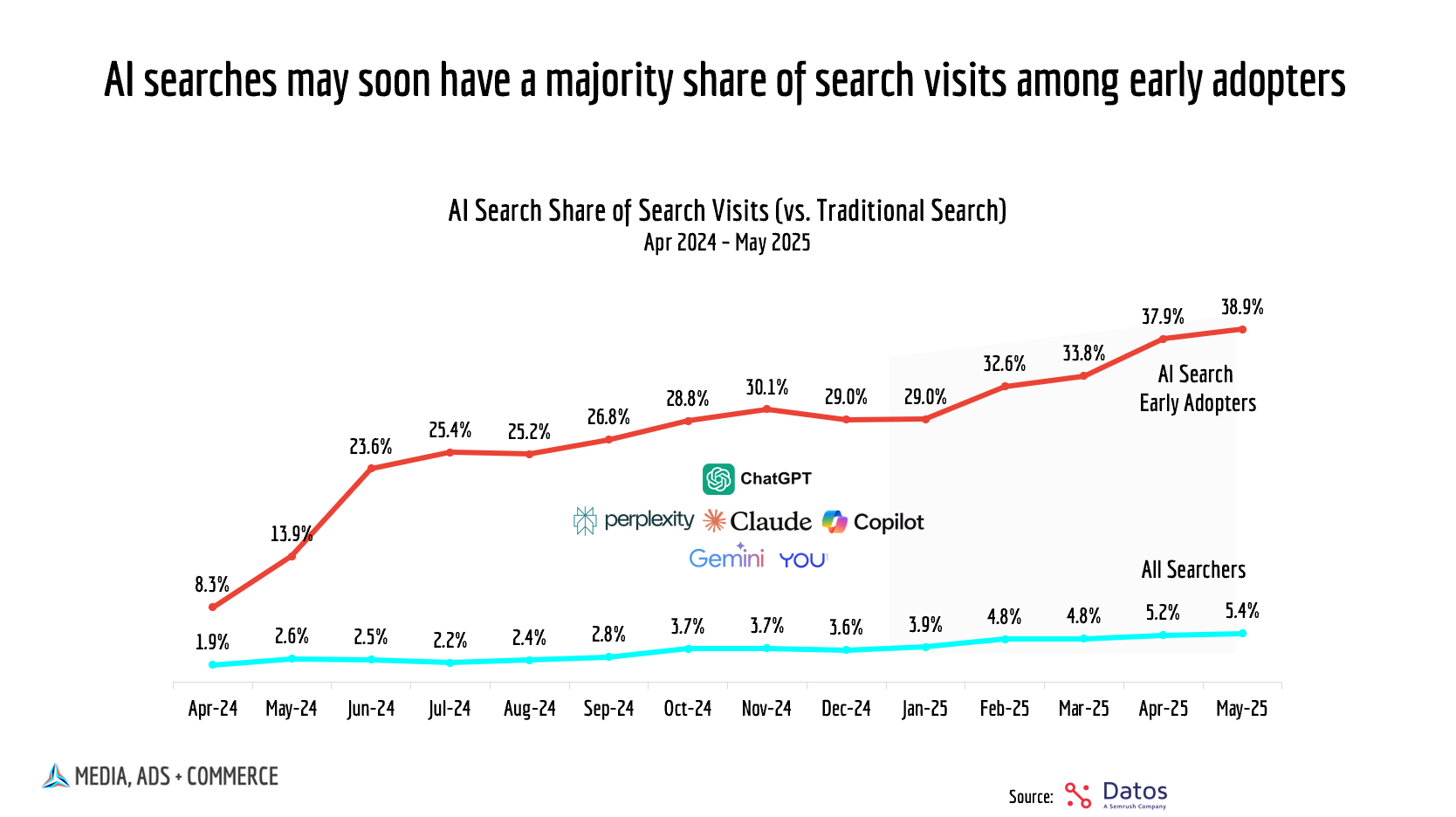
According to Datos, AI search is gaining share vs. traditional search engines—from 2% to 5% of search visits over the past year.
But among the sub-set of “early adopters”—defined as those with at least one visit to an AI search tool in April 2024—the shift is dramatic. In April 2024, 8% of their search visits went to AI search. By May 2025, that number had surged to 39%.
Methodology Note: The data displayed in this article has been provided by Datos, A Semrush Company. The analysis is based on Datos’s US clickstream data, representing a diverse and statistically significant sample of users, and covers the months of April 2024 - June 2025. For further information please visit Datos’s website and its Privacy Policy.
Traditional search includes Google, Bing, Yahoo, and DuckDuckGo. AI search includes ChatGPT (OpenAI), Claude (Anthropic), Copilot (Microsoft), Gemini (Google), Perplexity.ai, and You.com.
The analysis is based on “search visits,” which is akin to page views for the respective search channels. It should be noted that inherent differences in the UI between traditional search (i.e. distinct queries) and AI search (i.e. chat-based refinement of queries) may affect the extent to which each channel generates search visits.
Since mobile app usage is not included, these data do not represent the entirety of search behavior. No data set is complete or perfect, but the patterns within this panel of users should broadly represent the directional shifts across the broader internet population.
The cohort analyses discussed later in the article are based on a definition of searchers who used at least one AI search tool in the reporting month and did not use any AI search the preceding month.
Traditional search may be losing share but volume isn’t receding—at least not yet. According to Datos, the overall number of visits to traditional search engines is up 3.6% between April 2024 to April 2025.
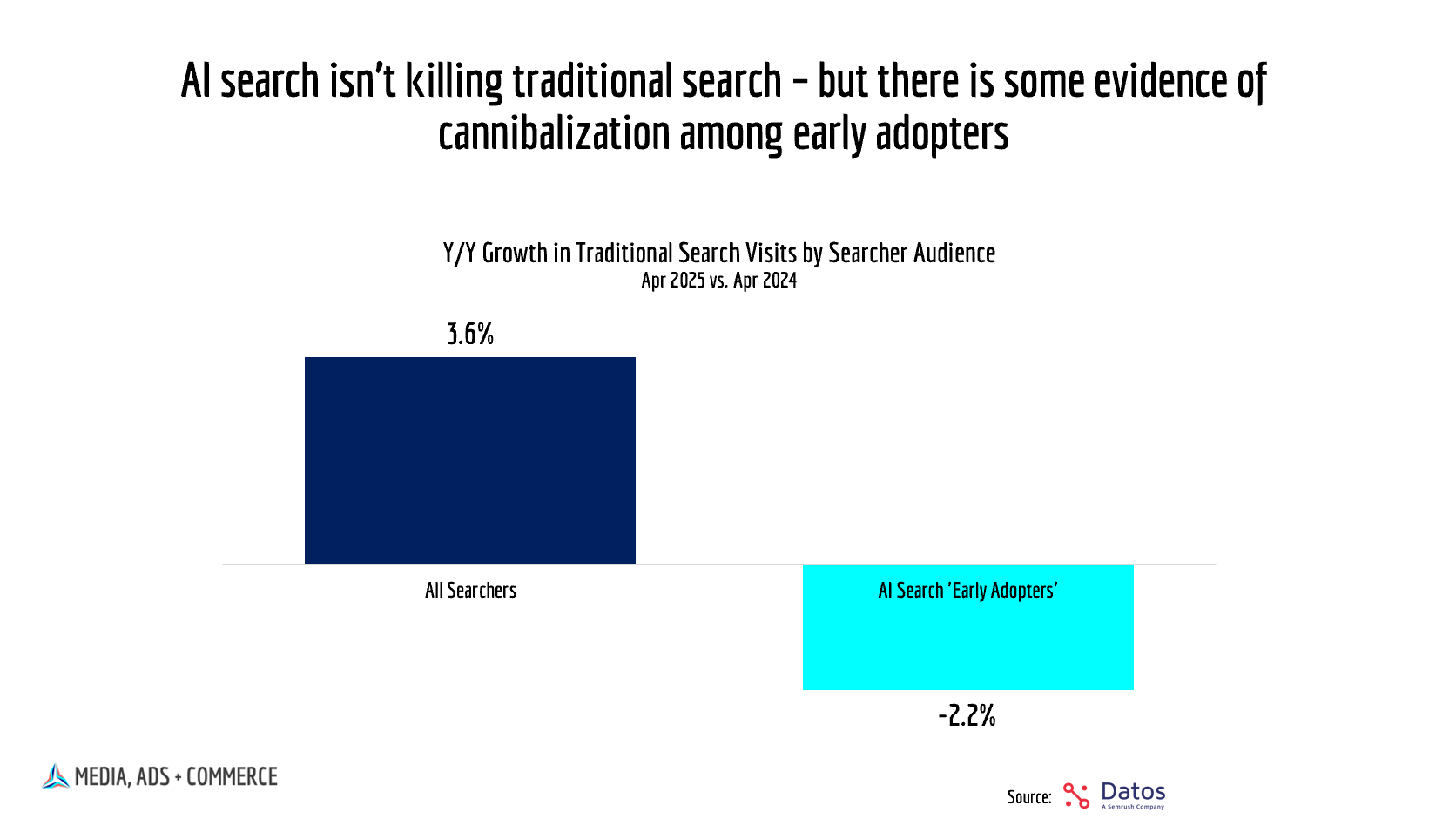
With traditional search visits down 2.2% among early adopters, however, the potential for cannibalization bares watching.
How should brands respond to the changing landscape? Patrick Coffee’s recent WSJ article offers some perspective:
Businesses should move cautiously despite the apparent speed of change, according to [Eli] Goodman, the Datos CEO. Search engines still handle an overwhelming majority of overall search traffic and remain firmly embedded in the smartphones that occupy so much of our time, he said.
Brands must also remember that AI searches often serve different needs than a traditional google search, he said.
“Over 90% of all of the AI searches are what we call informational or productivity-based: Help me solve this problem, help me answer this question,” said Goodman. Traditional search result pages, on the other hand, were designed to lead consumers out to other destinations online, he said.
It’s not uncommon for emergent technologies to create new occasions more than overtake existing ones. In the early 2010s, mobile usage was expected to kill desktop internet. But traditional web browsing remained stable for years, and has declined only 13% over the past decade.
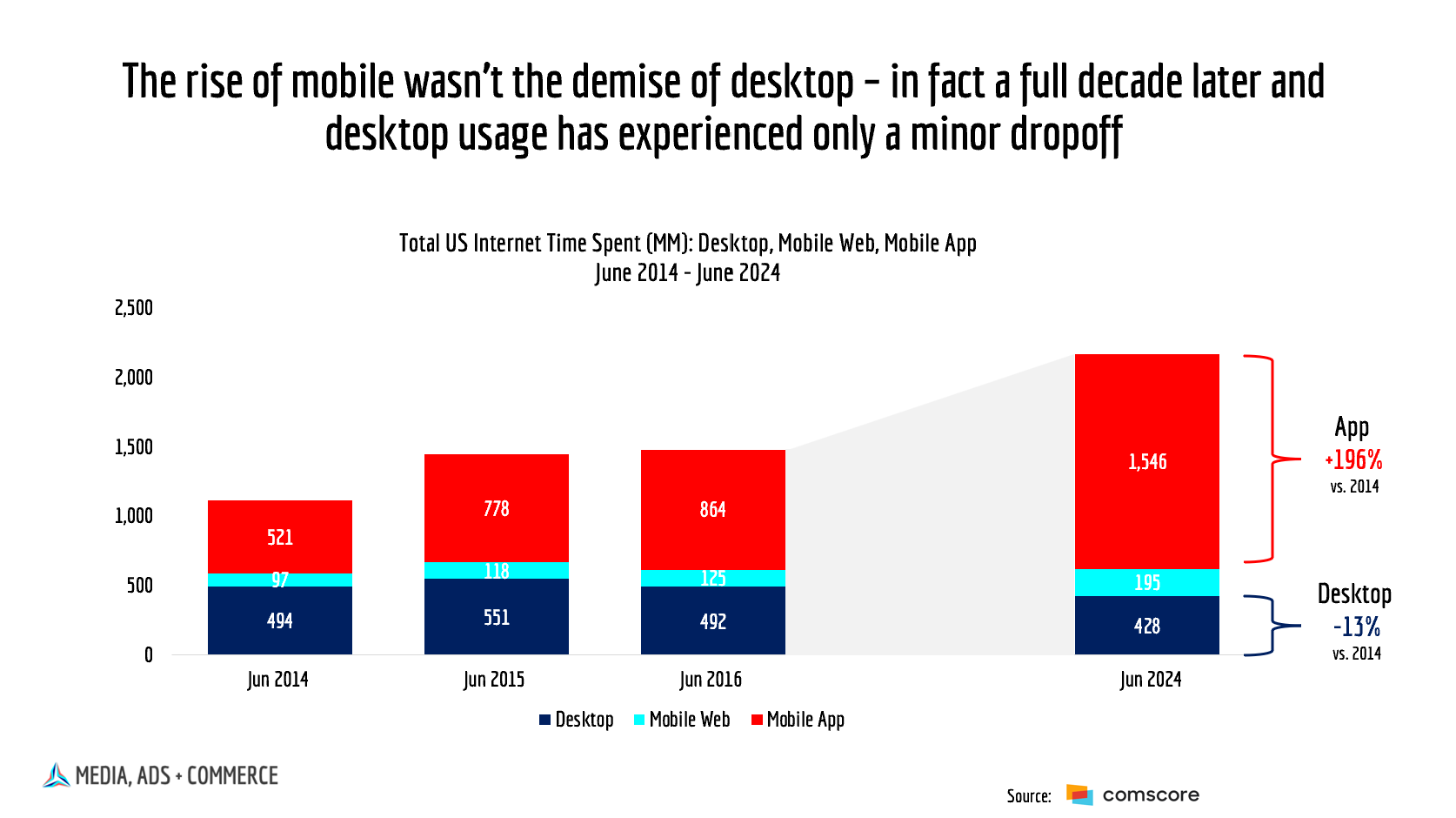
It’s not that behavior doesn’t shift, but the change is often gradual—even as reliance on the new technology grows.
It’s a Hard Habit to Break
There are few habits as sticky as Google search.
Search expert Gord Hotchkiss, founder of SEO agency Enquiro Search Solutions, explained the mechanism behind this in a January 2014 blog post:
“Habits depend on three things: high repetition, a stable execution environment and consistently acceptable outcomes,” he wrote. “Google was fortunate enough to have all three factors present.”
Indeed, Google’s search market dominance for the better part of two decades has been remarkable because at any time users could engage a different search engine. And yet they didn’t.
Google cultivated this powerful habit by delivering consistently high-quality results, in a predictable format, dozens and dozens of times per day for the average user. “Googling” became such a reflex that both Merriam-Webster and Oxford added it to their dictionaries as a verb in 2006.
The rise of mobile expanded its accessibility to nearly every waking moment of the day. Fifteen plus years of reflexive Googling has now deeply ingrained this behavior in most of the population. And it’s unlikely to change unless certain conditions occur, according to Hotchkiss:
Habits break down when there’s a shift in one of the three prerequisites: frequency, stability or acceptable outcomes.
If we stop doing something on a frequent basis, the habit will slowly decay. But because habits tend to be stored at the limbic level (in the basal ganglia), they prove to be remarkably durable…
A more common cause of habitual disruption is a change in stability. Suddenly, if something significant changes in our task environment, our “habit scripts” start running into obstacles…
A more permanent form of habit disruption comes when outcomes are no longer acceptable. The brain hates these types of disruptions, because it knows that finding an alternative could require a significant investment of effort.
Let’s examine how each of these factors could disrupt our collective Google habit:
Frequency – While the average internet user still relies heavily on Google, marginal shifts to alternative search experiences chips away at frequency and gradually erodes the strength of the habit. The habit remains durable, but not as durable as it once was.
Stability – For a long time, Google search results represented a stable environment. The typical query delivered a reliable list of organic results, with a paid listing or two at the top of the page, and a handful of ads on the side rail. The experience today is more chaotic. Every search results page feels different from the last, depending on the type of search. The page is overwhelmed with paid listings, AI overviews, videos, and related questions before the user has any chance of reaching a decent organic result.
Unacceptable Outcomes – This is the biggest threat to the Google habit. First, the rise in content clutter has degraded the search user experience. A 2025 Vox Media survey found that 66% of users believe information quality on Google is deteriorating and it’s harder to find reliable sources. Second, search alternatives now provide more acceptable outcomes with discernibly higher quality results and a cleaner user experience.
Google’s vulnerability stems in part from prioritizing its own traffic and monetization. Organic search results now represent a minority percentage of search clicks, slipping from 44% to 40% over the past year, according to Datos. At the same time, clicks to Google-owned properties jumped from 12% to 14% while zero-click searches spiked from 24% to 27%.
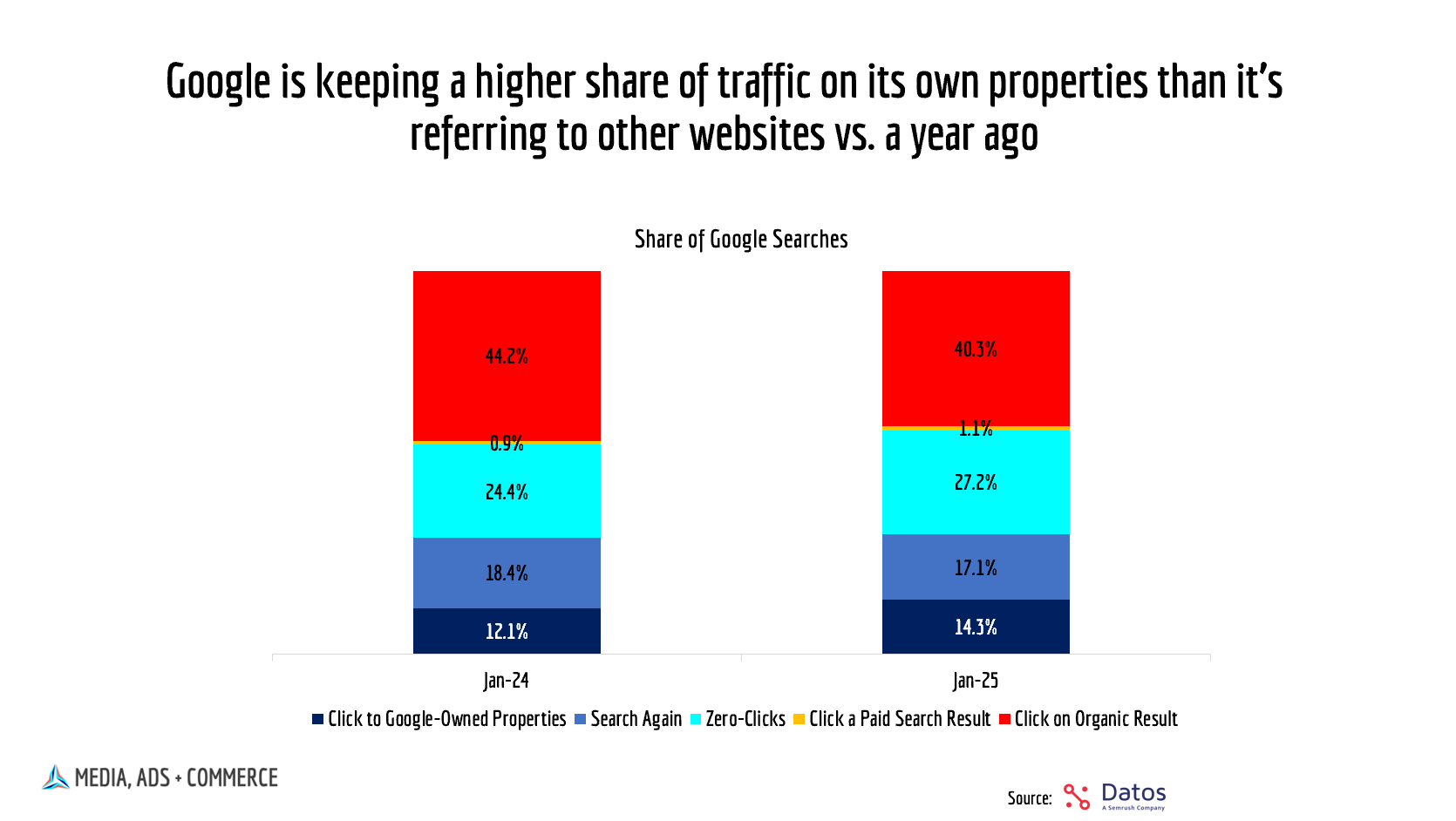
When users’ needs are no longer being met by a product, they will entertain alternatives. And with several emerging that are not just acceptable but offer noticeable improvement, the conditions now exist for the Google habit to break.
Do AI Search Early Adopters Predict Mainstream Adoption?
It’s fair to wonder whether early adopter search behavior predicts that of the mainstream and/or later adopters. Tech early adopters often gravitate to innovations that the mainstream never embraces, with cryptocurrency, NFTs, and the metaverse all recent examples of this.
To consider what future adoption might look like, I asked the analysts at Datos to run a cohort analysis. We examined the search visit share shifts for cohorts that began using AI search in April 2024, July 2024, October 2024, and January 2025. Each of these cohorts had at least 6 months of search activity to compare.
The analysis found that every cohort rapidly migrated to AI search, with an average increase of 8.6 percentage points in the first six months. The earlier cohorts – April 2024 and July 2024 – showed steeper increases, which appears to accelerate beyond that first six-month period. The later cohorts – October 2024 and January 2025 – saw slightly more gradual shifts over the first six months.
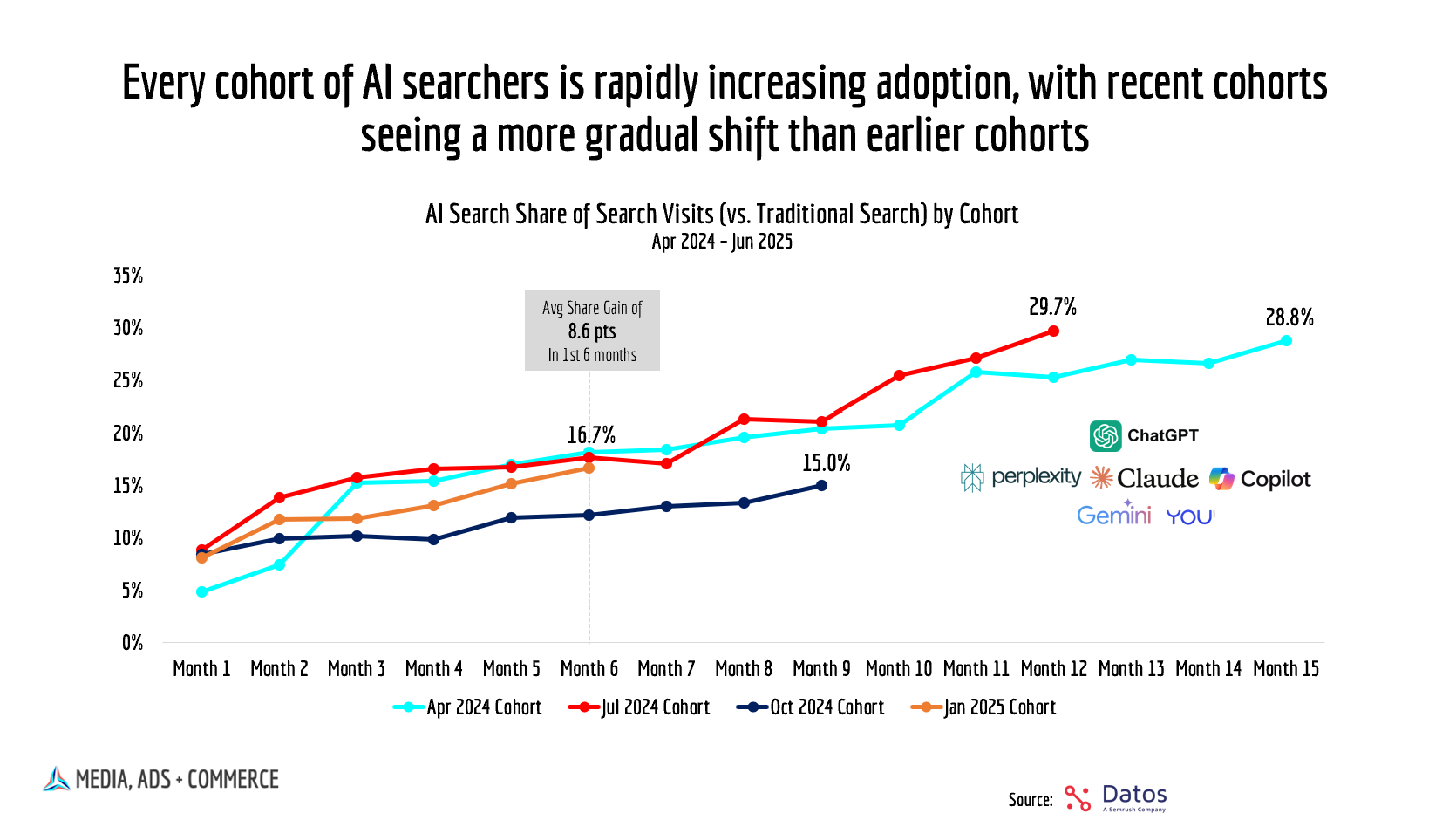
This suggests search user behavior will likely undergo drastic change in the next 12 months. Earlier cohorts could realistically become “AI-first” searchers, surpassing the 50% mark during that period. Later cohorts are likely to mature to somewhere north of 25%. And still-emerging cohorts should see their AI search activity climb well into double-digit territory.
Google search is a hard habit to break, but it’s not impossible. And if early adopters are any indication, it could happen sooner than we think.